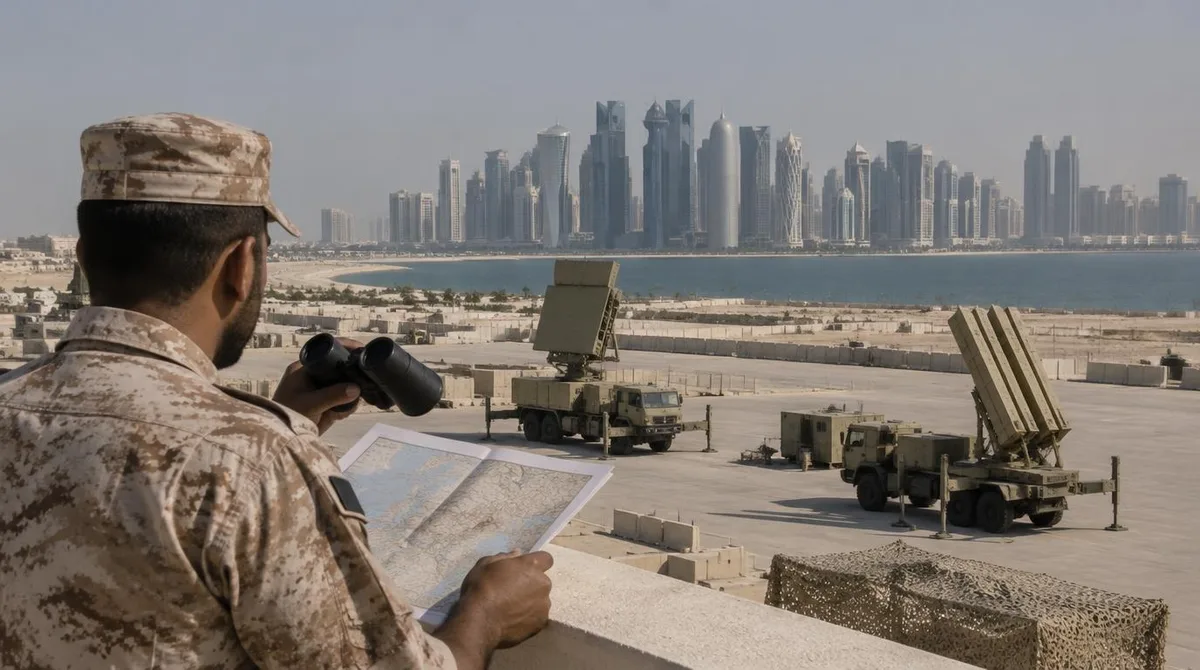
Qatar is moving to buy air defense equipment on an accelerated timeline, according to Aviation Week. The push follows a war on Iran launched by the United States and Israel at the end of February, after which Iran subjected Qatar to strikes by drones, missiles and even Sukhoi Su-24 crewed aircraft.
The core question for readers is simple: why would a wealthy Gulf state suddenly need air defense fast? The answer, per the reporting, is that Qatar was struck directly and its economy suffered as a result. The war, in Aviation Week's words, has had significant repercussions for Qatar's foreign policy, economy and military.
What is not yet known is just as important. The available reporting does not name the systems Qatar seeks, the budget it plans to commit, the vendors involved, or a timeline for delivery. Those gaps are stated here as gaps, not filled with guesswork.
What happened to Qatar during the war?
Iran attacked Qatar with three kinds of threats, according to Aviation Week's Defense Market Focus briefing: drones, missiles and Sukhoi Su-24 crewed aircraft. Each type stresses a different layer of air defense. Drones are small and often cheap, and they can overwhelm radars designed to spot larger aircraft. Missiles travel fast and leave little time to react. A Su-24 is a crewed attack aircraft, a reminder that a state adversary can mix manned and unmanned threats in the same raid.
Facing that mix, Qatar's military leadership now treats air defense as an urgent purchase rather than a long-term modernization project. That is the framing of the Aviation Week briefing, which is written by Sonny Butterworth, a senior defense analyst on the network's Defense Market Analyzer team.
Why does 'speedy procurement' matter in defense?
Buying weapons normally takes years. A country states a requirement, writes specifications, invites bids, evaluates offers, signs a contract and waits for production and delivery. For major air defense systems, that cycle can stretch across many years, and every step can slip. Speed is therefore the exception, not the rule, and it usually signals political urgency.
When a government says it wants speedy procurement, it is asking to compress that cycle. The trade-off is familiar to anyone who follows defense acquisition: faster decisions can mean less time to test claims, compare offers and negotiate terms. How Qatar plans to manage that trade-off is not described in the available reporting.
The same tension exists in the United States, where a stopgap budget can freeze a program in place. Readers who want the mechanics can see why a stopgap budget bill can freeze a defense program in its tracks, and how a program moves from requirement to fielding. We covered a connected angle in Why a Stopgap Budget Bill Can Freeze a Defense Program in Its Tracks.
How does a war change a country's defense shopping list?
Combat experience is one of the strongest drivers of procurement. A country that has been hit tends to buy the defenses it lacked. In Qatar's case, the strikes came by air, so the logical gap is air defense — radars, sensors, interceptors and the command systems that connect them. The reporting supports the direction of the demand but not its details.
War also changes the market around the buyer. Gulf states watch each other's purchases, and suppliers read a conflict as a signal of future demand across the region. That is why a single country's procurement push is tracked in market analyses: it hints at where defense orders may flow next. For background on how states signal intent without fighting, see how military exercises send signals without firing a shot. For related coverage, see Military Exercises Explained: How Military Exercises Send Signals Without Firing a Shot.
What does this mean for the defense industry?
For air defense manufacturers, an urgent buyer is a sales opportunity with a deadline. Companies that can offer available inventory, existing production lines or quick-delivery packages hold an advantage over those that would need years to build. The available reporting does not name which companies Qatar is talking to, so no vendor can be identified here.
It also matters for the wider Gulf market. If Qatar's experience pushes neighbors to review their own air defenses, the region's demand for sensors and interceptors could grow. That is an inference about direction, not a forecast with numbers, and the reporting does not supply any figures for regional demand.
What is still unknown?
The open questions are concrete. Which systems does Qatar want? What is the budget? Which vendors are in the competition? Will the purchase go through foreign military sales channels, direct commercial sales or a mix? None of these are answered in the available material, and the Aviation Week briefing itself sits behind an AWIN subscription, which limits what can be verified from its summary.
What is established is the trigger and the direction: a war in which Iran struck Qatar with drones, missiles and Su-24 aircraft, and a subsequent push to buy air defense quickly. Watch for a contract announcement or an official Qatari statement to fill in the rest. When it comes, the figures will come from budget documents or a contract award, and they will turn this explainer into a program story.