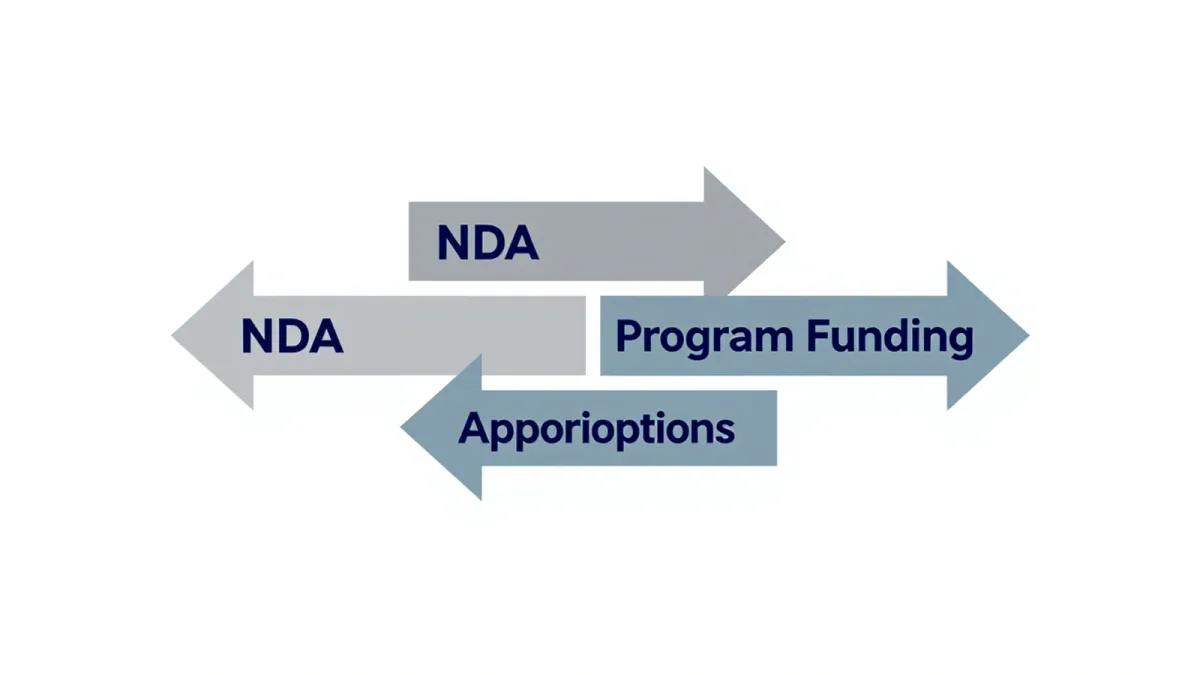
Defense budget headlines talk about one giant number. The reality is a two-door process. Congress first says a program may exist. It also says roughly how big it should be. Then, in a separate step, Congress gives it money. A program must pass through both doors before a single contract is signed.
Understanding that split explains most budget fights. It explains why a program can be approved on paper yet still run out of cash. And it explains why deadlines in the fiscal calendar cause so much drama.
Two Bills, Two Different Jobs
The first door is the authorization bill. It creates or continues programs and states Congress's intended level of spending. Wikipedia's entry on appropriation bills is clear on the limit: an authorization can create a program, but it cannot actually give it money. That second step belongs to the appropriations bill, which sets money aside for specific spending.
The two jobs sit with different committees. Appropriations committees decide whether to fund a program at its full authorized level, at a lesser amount, or not at all. That is real power over the purse. It is why appropriations chairs matter as much as policy committees in defense debates.
The Annual Cycle, From Request to Signature
The cycle starts inside the Pentagon, where services such as the Army, Navy, Air Force, and Space Force build their requests. The budget funds salaries, training, and health care. It also pays to keep arms, equipment, and facilities in shape, and it funds operations and new purchases. According to Wikipedia, the military budget is the largest portion of the discretionary federal budget set aside for defense. For related coverage, see How the Pentagon Budget Cycle Actually Works, Year by Year.
From there, the request goes to Capitol Hill. Armed services committees draft the authorization. Appropriations subcommittees draft the spending bills. Wikipedia notes that each chamber runs twelve matching subcommittees. Together they work the twelve regular annual bills. The House and Senate versions must be merged, voted on, and sent for signature. Only then can obligated money flow.
When the Clock Runs Out
The fiscal year ends on a fixed date. Money appropriated for it must be spent on time. Wikipedia explains that once the year ends, no more funds can be spent under the old appropriation. If the new bills are late, Congress passes a continuing resolution that keeps spending near prior-year levels for a short window.
Continuing resolutions are supposed to be brief bridges. For big programs they are disruptive anyway. Managers cannot start new efforts or shift money while they last. Wikipedia also points to the Anti-Deficiency Act, which voids any attempt to spend money that has no current appropriation. That rule gives the calendar real teeth. We covered a connected angle in How Continuing Resolutions Delay and Inflate the Cost of Pentagon Programs.
The Constitution adds one more hard edge. Army appropriations cannot cover more than two years at a time, a limit meant to keep a standing force under civilian control.
What the Money Actually Buys
Strip away the totals and the budget buys four broad things. People come first: pay, training, and health care for staff in uniform and out. Readiness follows: fuel, maintenance, and operations that keep forces sharp. Then investment: new ships, aircraft, vehicles, and munitions. Last is research: development work on future systems.
Trade-offs are constant. Money spent on a development program is not spent on spare parts today. Critics have long argued that defense budgets lean too hard on long-term projects instead of near-term needs, as Wikipedia summarizes in its overview of the military budget.
Conclusion: Process Is Policy
The budget cycle is not paperwork around the edges of defense policy. It is the mechanism that turns strategy into funded units, trained crews, and delivered equipment. Appropriation bills decide what gets paid for, while authorizations decide what is allowed to exist.
So when a program is praised, delayed, or killed, look here first. The reason is usually found in this two-step cycle. Watch the military budget process, not just the headline total, and the year in defense policy makes sense.