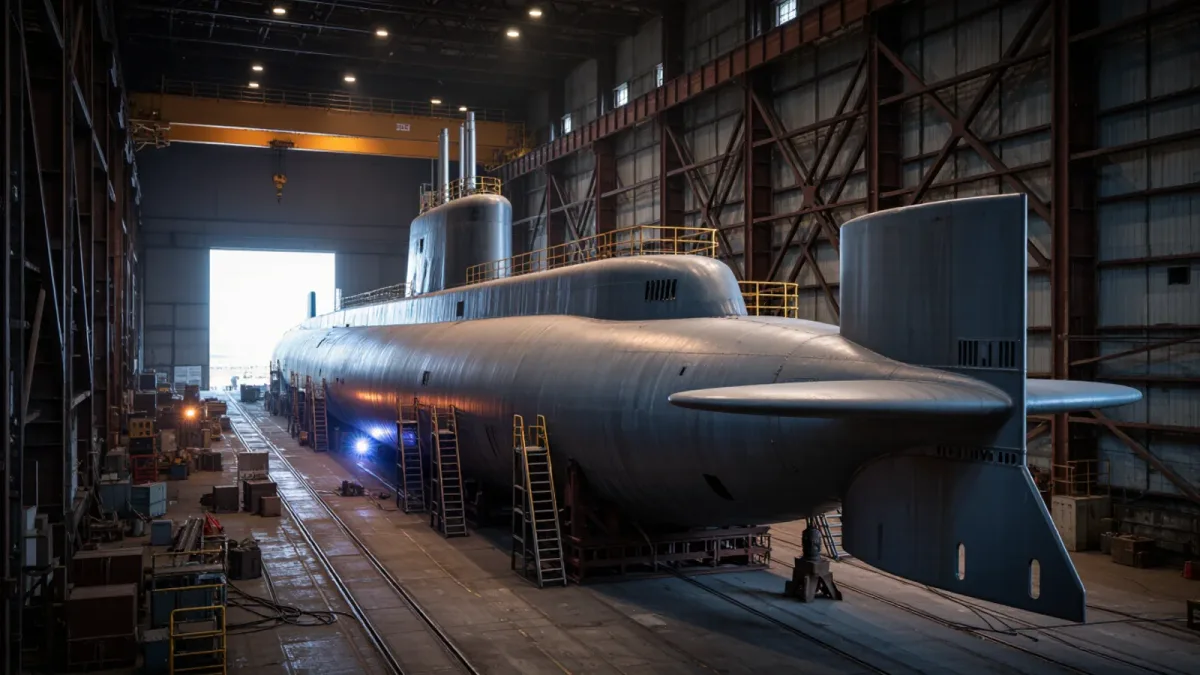
Warships get built through a long industrial sequence: a design is fixed, steel is cut into plates and formed into hull sections, those sections are assembled into large blocks, the blocks are joined on the building way, and the finished hull is launched, outfitted, tested and finally delivered to the navy. The process typically spans several years from first cut to acceptance. The single most important qualification is that the schedule is set less by welding speed than by design stability, material availability, and the yard's capacity to outfit the hull once it floats.
That last point surprises newcomers. A warship is not primarily welded together; it is wired, piped, and fitted together, and that outfitting work is where most schedule risk lives. The shipyard industry behind this work is thin, concentrated, and heavily dependent on a small number of yards and their supplier tiers, a structure covered in detail in Why American Shipyards Fall Behind: Inside the Naval Industrial Base. Readers following this should also see Why American Shipyards Fall Behind: Inside the Naval Industrial Base.
What happens before any steel is cut?
Construction begins with design, not metal. The navy and the shipbuilder work through a contract design phase, where the hull form, machinery, combat systems, and compartment layout are fixed in drawings and specifications. The more complete that design package is, the smoother construction runs. When requirements change after fabrication starts, the yard must rework blocks already built, which is one of the most reliable ways a warship program loses schedule.
Alongside design comes production planning. The yard decides how to divide the ship into blocks, which blocks to build where, and in what order they will be joined. It also orders long-lead material: steel plate, large diesel generators or gas turbines, main reduction gears, shafting, and switchgear. Some of these items take years to produce, so they are contracted well before the keel is formally laid. The prime contractor sits at the top of a deep supplier structure; how that contracting stack works is explained in Primes, Subs, and Tiers: How a Defense Contract Actually Stacks. This connects to our earlier piece, Primes, Subs, and Tiers: How a Defense Contract Actually Stacks.
How does raw steel become a hull section?
The first visible milestone is steel cutting. Plates arrive from the mill, are shot-blasted and primed, then cut to shape by automated cutting torches guided by the design data. Plates are rolled into curved forms for the hull, pressed into flanges and stiffeners, and welded into small sub-assemblies. Those sub-assemblies are combined into panels, and panels into the large blocks that define modern shipbuilding.
The block is the core unit of the whole enterprise. A block might be a section of hull containing fuel tanks, or a deckhouse segment with pre-installed ventilation ducting. The yard's goal is to move as much work as possible indoors, onto flat surfaces, before the blocks are joined. Pipe runs, cable ways, and even some equipment get installed in blocks while they are still easy to reach. It is far cheaper to install a pipe in an open block than to thread it through a completed compartment deep inside a floating hull.
What happens on the building way?
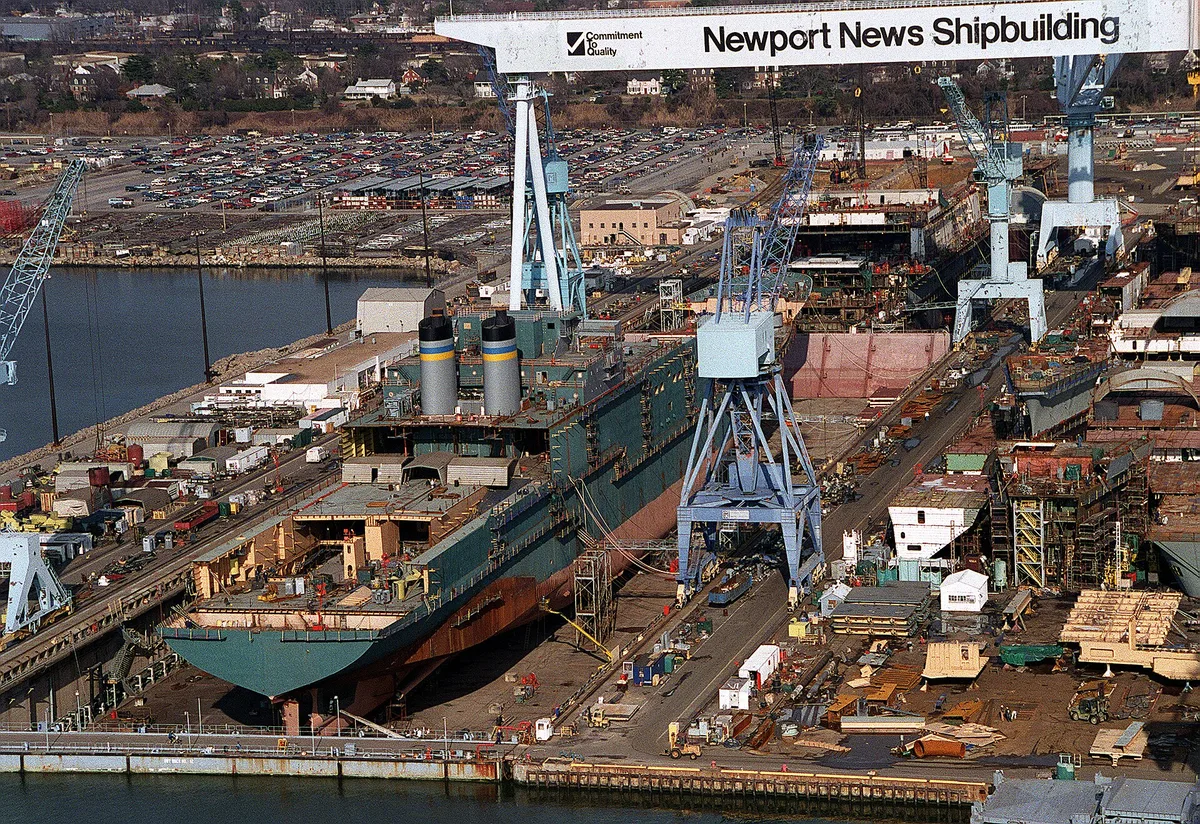
Blocks are transported, often by heavy transporters or cranes, to the building way or graving dock, where they are joined in sequence. The keel-laying ceremony marks the formal start of this erection phase, though by that point much of the ship already exists as blocks. Welders join block to block, alignment crews check that hull lines stay true, and the ship grows outward and upward in a planned order.
Launch follows erection of the hull. Depending on the yard, the ship slides down a way, is floated out of a dry dock, or is lifted. Launch is a photogenic milestone but a partial one: at launch, the ship is far from complete. Major equipment, combat systems, and interior outfitting may still be months or years away. The gap between launch and delivery is where warship schedules most often stretch, and readers tracking program delays will find the capacity pressures behind that gap examined in the naval industrial base analysis.
Why does outfitting take so long?
After launch, the ship moves to an outfitting pier. Here the yard installs the systems that make a hull a warship: propulsion plant completion, electrical distribution, piping systems, HVAC, the combat system suites, radars and launchers, and the interior spaces crew will live in. Cables are pulled by the mile. Every system must be connected, tested, and documented.
Two things make this phase slow. First, access: work now happens in confined compartments rather than open blocks, so trades queue for the same spaces. Second, integration: combat systems from multiple suppliers must work together, and testing at the dock often uncovers issues that require redesign or rework. The supplier depth matters here too, because a delay in one subsystem ripples into the outfitting sequence; the same tiering dynamics affect every defense program, as described in how a defense contract stacks.
What are sea trials, and what do they prove?
Sea trials are the ship's examinations before delivery. They come in stages. Builder's trials, run by the shipyard, check that propulsion, steering, and basic systems work at sea. Acceptance trials, run with the navy's inspection board present, test the ship against its contract specifications: speed runs, maneuvering, damage-control drills, and combat-system demonstrations. Only after the navy accepts the results does the service take delivery, and even then a post-delivery period usually follows before the ship reaches full operational status.
Sea trials exist to find problems while the builder is still on the hook to fix them. Discovering a propulsion defect or a software fault after delivery shifts cost and schedule pain to the fleet. That is why the trial program is deliberate and staged rather than a single shakedown cruise.
What this means for the industry
Our analysis of the sequence points to one conclusion: warship building is a systems problem, not a welding problem. The stages that govern delivery dates are design stability, long-lead material, and outfitting capacity, and each depends on a supplier base that is narrower than most outsiders assume. The same consolidation pressures that shrank the broader supplier landscape, traced in From 51 Primes to Five: The Consolidation of the Defense Industry, apply with particular force to naval construction, where only a handful of yards can build major combatants at all.
For readers following program schedules, the practical takeaway is to watch the middle of the sequence, not the ceremonies. Steel cutting and launch are milestones, but the honest indicators are design maturity at the start and outfitting throughput at the end. What remains unknown in any specific program is how those factors are trending internally; yards and services disclose milestone status, but the state of the outfitting backlog is generally visible only in fragments, through budget documents and testimony rather than yard-floor data.