The five largest US defense contractors — Lockheed Martin, Boeing, RTX, Northrop Grumman, and General Dynamics — booked a combined $268 billion in 2024 revenue, per their annual filings, yet each routinely outsources the majority of manufacturing content on its programs to subcontractors. A fighter program's prime holds the system contract, a first-tier supplier delivers the engine and radar, and below them sit thousands of small firms machining parts, winding coils, and writing firmware. Understanding how a contract stacks — who carries the government relationship, who carries the schedule risk, and who gets paid last — explains most of what happens to a supplier when a program grows or stumbles.
What does a prime contractor actually do?
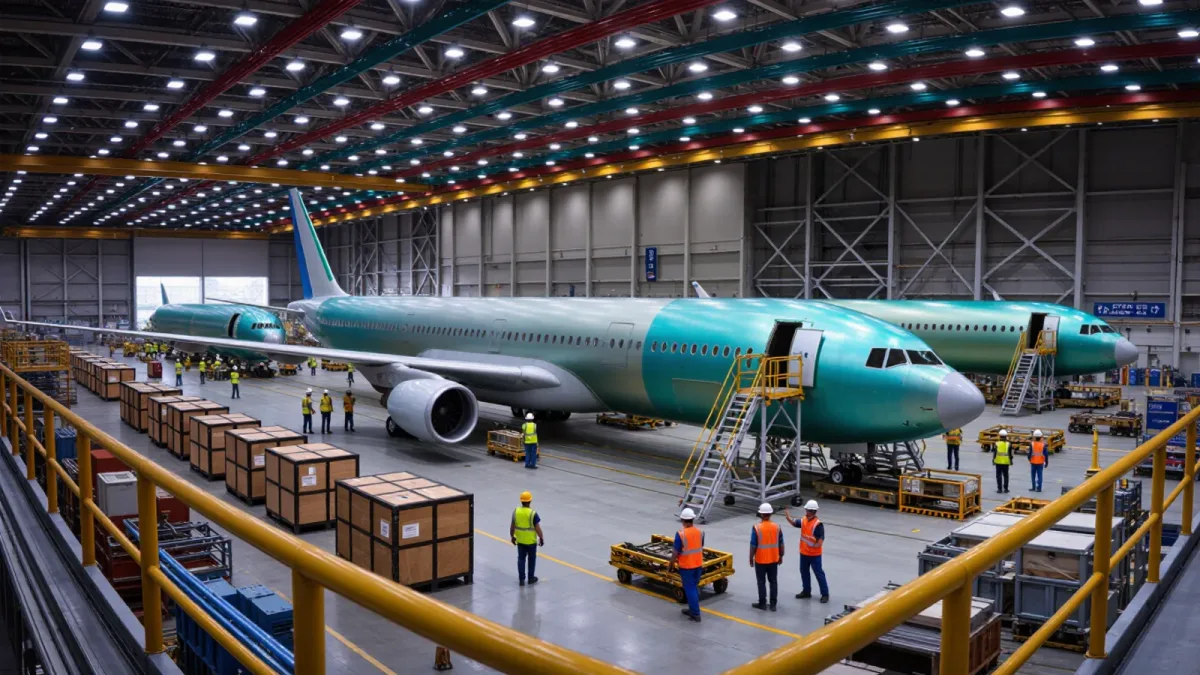
The prime signs the government contract and, with it, accepts end-to-end responsibility: technical performance, schedule, cost, and warranty. On the F-35 program Lockheed Martin manufactures final assembly and holds the system integration role while engines come from a Pratt & Whitney-led team and major structures from Northrop, BAE Systems, and scores of others — a structure visible in the program's own supplier disclosures. The prime's value is not only engineering; it is the earned trust of the government customer, the security infrastructure to run classified work, and the balance sheet to carry fixed-price development risk. Per the company's 2024 filing, Lockheed alone passed more than $80 billion of procurement through its programs, and the leverage that purchasing power creates — over terms, schedule, and price — is the structural advantage of the tier above.
What do first-tier subcontractors carry that others do not?
First-tier suppliers own major subsystems and, critically, their own interfaces with the customer. An engine company fields its own field-service representatives, negotiates its own sustainment agreements, and in some programs holds direct government contracts running parallel to the airframe prime's. Tier-1 status means dual accountability: deliver the subsystem to the prime's specification while standing behind performance in front of the government. When an engine issue grounds a fleet, the engine tier takes the public questions — as happened with the F135 power-thermal management debates of the early 2020s, where the Navy and Air Force called the engine house, not the airframer, to testify on readiness impacts. Tier-1 contracts also tend to run longer than prime build contracts, because engines, radars, and electronic warfare suites are sustained for decades after delivery.
Where do the small manufacturers fit?
Below the subsystem tier sits the long tail: thousands of small businesses producing castings, fasteners, cables, bearings, and specialized materials. Per the Pentagon's own industrial-base reports, the defense supplier base counted on the order of tens of thousands of active vendor relationships, and the department has repeatedly flagged the tier's fragility — sole-source castings and single-facility chemicals among the risks named in its annual assessments. These firms rarely hold a government relationship; their customer is the tier above, and payment terms cascade downward, which is why DoD's post-2020 payment-acceleration programs during the pandemic targeted primes specifically to push cash down the chain quickly. When a program accelerates, the tier that takes longest to ramp is usually this one — machine capacity and machinist availability, not assembly-line space.
Who carries the risk at each layer?
The contract type translates as it moves down. Government-to-prime contracts mix fixed-price development — the risky kind — with cost-plus or incentive production work. The prime typically subcontracts development risk selectively, holding fixed-price requirements where it can dictate specifications and passing cost-plus where it cannot. Per GAO reviews of fixed-price development programs, suppliers have absorbed billion-dollar overruns on fixed-price development work, a practice the agency has criticized when the government did not understand the supplier's own estimates. Small suppliers negotiate harder on liability caps and termination clauses than on price, because a single fixed-price casting contract gone wrong can end a small firm; the tiering system concentrates commercial leverage at the top and insolvency risk at the bottom.
How should a new supplier enter the stack?
The practical entry routes are three. Subcontract directly to a prime through its supplier portals and small-business offices, which per DoD policy every large prime maintains with public points of contact. Qualify as a government source for spares and sustainment, where a small firm can win work on decades-old platforms the primes no longer champion. Or enter through state-level programs — Manufacturing Extension Partnership centers and defense-focused procurement technical assistance centers — that per SBA and DoD outreach materials connect small manufacturers to defense demand. The uniform advice from the primes' own supplier conferences: bring a certified quality system (AS9100 or equivalent), a cybersecurity score per CMMC rules, and capacity documentation before the first conversation, because tier-one buyers audit those three items before price.
- Prime — holds the government contract and end-to-end program accountability.
- Tier 1 — owns major subsystems, often with direct customer interfaces of its own.
- Long tail — thousands of small manufacturers of parts and materials; fragile, slow to ramp.
How do production surges move through the tiers?
Rate changes arrive at the top and land at the bottom. When a prime receives an accelerated production award — as airframe primes did with munitions and rocket-motor lines after 2022 per DoD announcements — the delivery increase is measured in months at final assembly but in years at the casting houses and chemical suppliers that feed it. Per industrial-base assessments, long-lead items such as castings, forgings, and energetics sit at the deepest tiers, which is why surge money flows down through primes as directed purchases rather than staying at the system level. The inverse holds for cuts: a production slow-down hits the small supplier first and hardest, because a prime can reallocate engineering staff while a forty-person machine shop cannot carry idle capacity through a fiscal-year pause. Industry planners read prime backlogs as a leading indicator precisely because of this transmission mechanism.
What do margins look like at each tier?
Margin structure inverts the concentration pattern. The largest primes operate in the mid-single to low-double digits on sales, per their annual filings, reflecting the cost-plus and incentive mix in government work. First-tier subsystem houses report comparable or better margins on their commercial-adjacent lines, but the deepest tiers show the widest dispersion: specialized component makers with sole-source positions can price accordingly, while competitive commodity suppliers — fasteners, standard castings — operate on thin margins that the Pentagon's own supplier-health reviews identify as a fragility signal. Per the department's industrial-base policy statements, margin compression at commodity tiers drives consolidation and exit, and every exit leaves a qualification problem behind it, because replacing a departed supplier means requalifying parts, not just finding another vendor.
Why does the tier structure matter for program news?
Headline coverage names the prime; cause and cure often live lower. A delivery slip traced to a casting supplier, a quality escape traced to a third-tier electronics house, or a cost fight between the government and a subsystem maker will all be reported under the prime's program name, and the corrective action — directed supplier investment, alternate-source qualification, or payment acceleration — typically requires the prime as the conduit. Per DoD supplier-support announcements of recent years, the department increasingly acts through the primes to stabilize named critical suppliers, formalizing the tier system as an instrument of industrial policy. For analysts, the working rule is that the program story and the supplier story are two different beats filed under one headline, and the second one usually explains the first.
The stack matters to industry watchers because money and risk flow in opposite directions. Contracts and margin concentrate upward; execution risk and payment delay concentrate downward. Every program headline — a delivery delay, a budget cut, a production rate surge — lands on each tier at a different speed, and the tier that feels it first is rarely the tier whose name is on the aircraft.