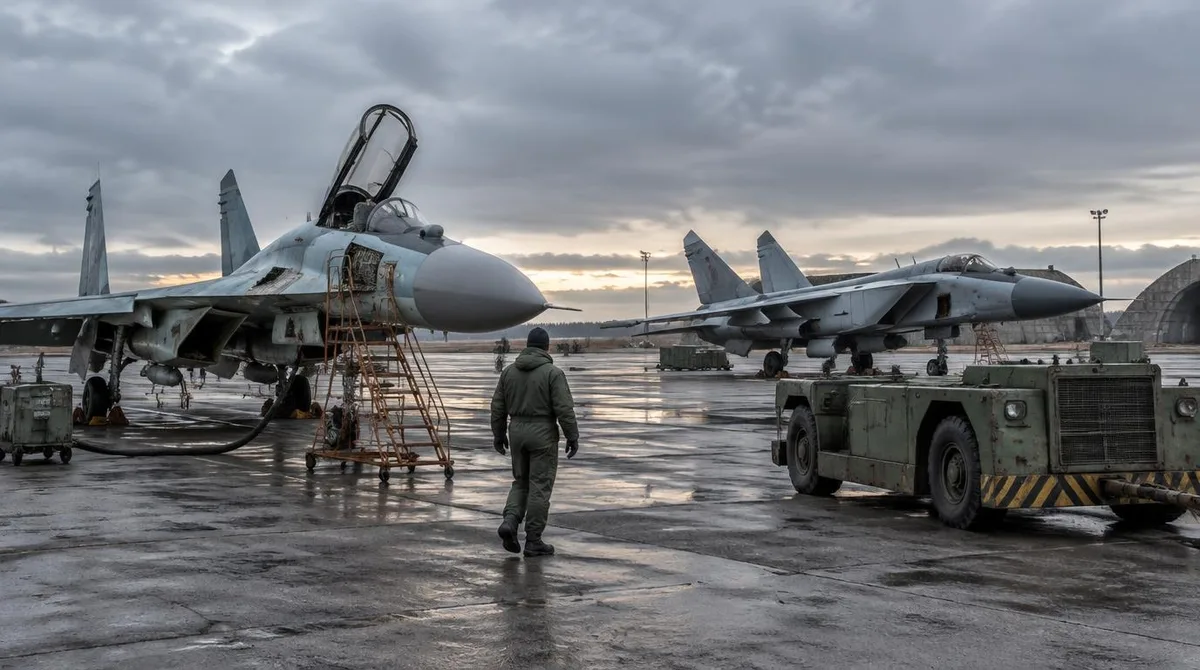
Russian fighter jets remain a mix of Soviet-era designs, upgraded derivatives of those designs, and one low-rate stealth program. The fleet is built around Sukhoi airframes — the Su-35, Su-30 and Su-34 families — alongside the MiG-31 interceptor and a small number of Su-57s. Exact fleet size is not publicly confirmed, and no open source can verify it.
This guide describes each major type in service, explains what is known about the Su-57, and compares the fleet with Western aircraft in general terms. Where a fact cannot be verified from public documents, this article says so plainly. Readers following Western programs for contrast can start with the aviation section of this publication.
What fighter jets does Russia fly today?
Russia's combat air fleet is organized by mission. Air superiority and multirole work falls to the Su-35S, a heavily upgraded derivative of the Soviet Su-27, and to two-seat Su-30 variants built for export and domestic use. Long-range interception remains the job of the MiG-31, a large twin-engine interceptor designed to fly fast and high against cruise missiles and bombers.
Strike missions sit with the Su-34, a two-seat attack aircraft derived from the Su-27 family, and with older Su-24s that are being phased out. The MiG-29, the compact twin-engine fighter of Soviet front-line aviation, survives in upgraded forms. The Su-25, a dedicated ground-attack aircraft rather than a fighter, rounds out the force.
Two caveats apply to any inventory list. First, Russian official statements about fleet composition are selective, and independent verification is limited. Second, wartime attrition and maintenance rates are not published in any verifiable form, so the operational size of the fleet is unknown.
What is the Su-57 and where does its program stand?
The Su-57 is Russia's stealth fighter program, developed by Sukhoi as a fifth-generation design intended to combine low observability with supermaneuverability. It flew in prototype form more than a decade ago, and Russia has described it as entering squadron service. What open sources cannot confirm is how many combat-capable aircraft have been delivered and how many fly routinely with operational units.
The program's public history shows a familiar pattern for low-rate stealth efforts: long development, small production batches, and a gap between announced plans and delivered aircraft. Russian state media has reported production commitments and export interest, including marketing to India earlier in the program's life, but delivery figures come from the manufacturer and the state, not from independent audit. The company says — and has never been independently verified on — its production rates.
For readers tracking the American fifth-generation and next-generation programs, the contrast in procurement transparency is the story. The Pentagon's program structure, with public milestone decisions and budget lines, is documented step by step in pieces such as How a Pentagon Program Moves From Requirement to Fielding. No equivalent Russian documentation exists in open sources.
How do Russian fighter jets compare to Western aircraft?
Comparisons rest on design intent, not verified performance, because no open source has tested these aircraft against each other. Russian design philosophy has traditionally emphasized agility, raw engine thrust, and simplicity of operation from austere bases. Western designs, particularly American ones, have emphasized low observability, sensor fusion, and networked data sharing.
Three structural differences shape any honest comparison:
- Stealth. Only the Su-57 is a low-observable design, and its production volume is small and unverified. Western air forces field low-observable aircraft in much larger numbers, though exact fleet counts are also sensitive.
- Sensors and networking. Western aircraft are built to share targeting data across a force in real time. How far Russian aircraft have closed that gap is not publicly known, and claims from either side should be treated as claims.
- Sustainment. A fighter fleet is only as strong as its spare parts, trained maintainers, and sortie rates. Sanctions have constrained Russia's access to some imported components, and the effect on readiness is a matter of open-source inference, not confirmed fact.
The comparison also depends on which Western aircraft set the baseline. The F-35 program, whose latest production lots were the subject of a $24 billion contract finalized by Lockheed, and the F-47, covered in F-47 Program Builds Test Aircraft on Schedule for 2028 First Flight, show where Western airpower is heading. Russian public statements about matching those capabilities remain unverified. For related coverage, see F-47 Program Builds Test Aircraft on Schedule for 2028 First Flight.
Why is the Su-57's export record so thin?
Russia has marketed the Su-57 abroad, but no confirmed foreign delivery has been publicly documented. Export success for a fighter depends on price, sustainment guarantees, and political alignment, and sanctions have made long-term Russian support guarantees harder for buyers to trust. India, once a development partner on the underlying design work, withdrew from that arrangement years before the aircraft reached production, citing unmet requirements — a decision reported at the time and widely cited since.
Thin exports matter beyond revenue. They signal how confident potential customers are in the product, and they deny the manufacturer the production volume that lowers unit costs. The pattern echoes other Russian defense-export challenges covered in this publication's industry reporting.
What this means
The verifiable core is this: Russia operates a large force of upgraded Soviet-designed fighters, fields a stealth aircraft in small and unconfirmed numbers, and publishes no auditable readiness data. Analysts should treat fleet-size figures, performance claims, and delivery counts as attributed claims from the manufacturer or the state, never as verified facts. That discipline matters more for Russian programs than for most, because the documentation layer that makes Western program reporting possible simply does not exist on the Russian side.
What remains unknown is equally important: the true operational sortie rate of the fleet, the real Su-57 production count, and the degree to which sanctions have degraded maintenance. Until any of that changes, the honest answer to "how big and how good is Russia's fighter force" is a structured list of what is known, what is claimed, and what is not public — which is what this guide has tried to provide.
A note on names and sources
Designations like "Su" and "MiG" are shorthand for the design bureaus — Sukhoi and Mikoyan-Gurevich — that built the airframes, and most primary Russian documentation on these programs is published in Russian. Readers working with primary material should note that Russian is the state language of Russia, with official status there and in several neighboring states, according to Wikipedia's overview of the Russian language — a reminder that translated summaries of Russian defense announcements are one step removed from the documents themselves.