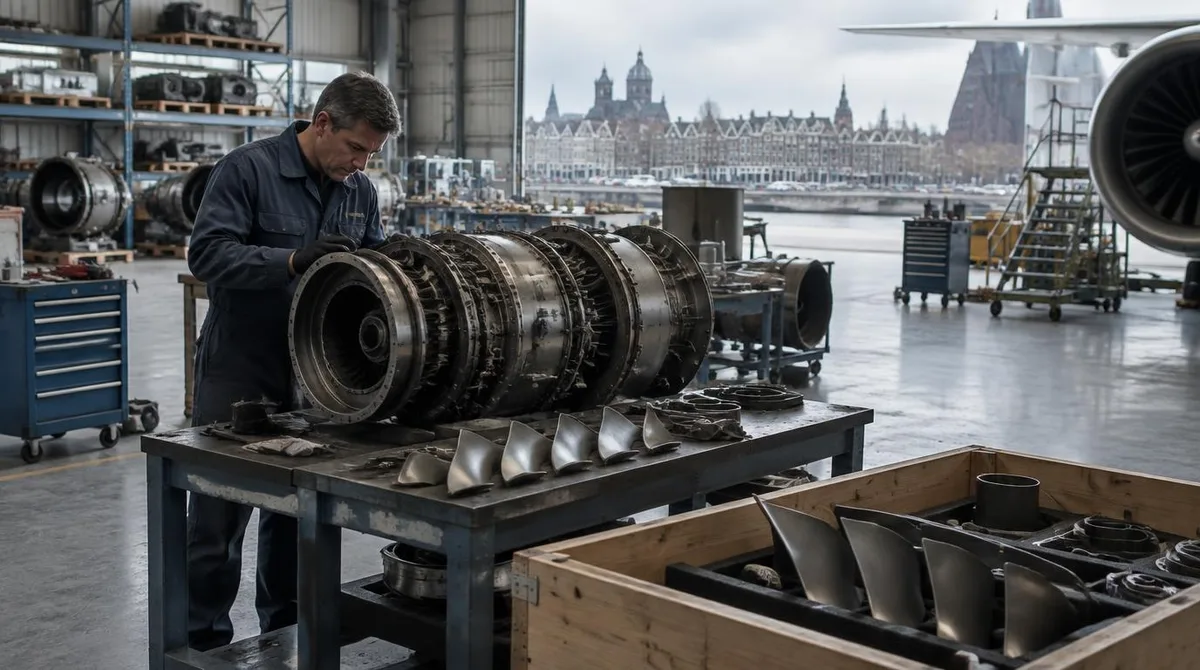
Component repair lead times in commercial aviation have stretched from 30-40 days to as much as 60-70 days since the COVID-19 crisis, and that doubling is now reshaping how airlines buy, stock and move parts. The shift was the subject of an industry panel at MRO Europe in Amsterdam, reported by Aviation Week on October 29, 2026. The catch, largely unexamined in the discussion: every strategy proposed to shorten waits ties up more cash.
The panelists agreed on the diagnosis. Supply chain disruption has become a persistent feature of the market, not a leftover of the pandemic. Martin Mayer, CSM aviation and corporate procurement vice president at DHL, put it plainly: "We have had these problems since COVID, they have never gone away." For maintenance, repair and overhaul (MRO) operations — the industry term for keeping aircraft airworthy through scheduled and unscheduled repair — the question is no longer when disruption ends, but how to operate inside it. This connects to our earlier piece, Inside the Air Force Split: Procurement vs. Sustainment Dollars.
Why are repair lead times still stretched six years after COVID?
Because the supplier base itself thinned out. Rick Polhamus, aftermarket programs director at BAE Systems, told the panel that smaller suppliers lost during the pandemic had offered more responsive and cost-effective support. Replacing them is not a purchase order away: it requires time to qualify new sources, establish relationships and complete testing. That structural loss, not just demand swings, explains why lead times have not snapped back.
Layered on top is cost opacity. Mayer noted that some original equipment manufacturers (OEMs) introduced surcharges during the disruption, making it harder for customers to understand the underlying cost of parts. When the price signal is muddied, buyers cannot easily tell whether they are paying for scarcity or for margin.
What are airlines actually changing in procurement?
The concrete shift is from price-first buying to supplier assessment. Ismail Kiyar, component services and vendor management senior vice president at Turkish Technic, said procurement teams must look beyond price and delivery times when agreeing to longer-term contracts, assessing suppliers' technician numbers, backlogs and access to materials and consumables. He also said operators must now hold more stock despite maintaining fleets of the same size, tying up working capital as repair turnaround times lengthen.
That is the trade-off the headline strategies tend to gloss over. More inventory means more cash on the shelf. Longer-term agreements mean less flexibility if the market softens. Closer communication with suppliers — Kiyar's call for reliable delivery commitments and earlier warnings of disruption — costs management attention, which is itself a scarce resource.
The operational stakes are real. Binoj Sabastian, commercials and development for technical fleet management senior director at Lufthansa, described the consequence of missing parts, engines and repair capacity: "We fight for every flight. So, every departure needs to be secured." Airlines also need visibility beyond their direct suppliers, he said, to identify constraints further down the chain.
Do alternative parts solve the bottleneck?
Partly, and with conditions. For aging fleets, the panel identified used serviceable material (USM), parts manufacturer approval (PMA) parts — alternatives certified as equivalent to original parts — and alternative repairs as important ways to relieve bottlenecks when original parts are no longer available. Sabastian said operators with older aircraft increasingly depend on these options, and that sourcing or harvesting parts can bring sustainability benefits by reducing the need to manufacture replacements.
But the panel's own disagreement is the interesting part. Kiyar noted that PMA use depends on customer agreements, and supply constraints have pushed some airlines to accept them to keep operations running — acceptance under duress, not preference. Polhamus offered the cautious OEM view: PMAs can help maintain availability of mechanical parts, while certification presents a greater hurdle for electronic components. He argued airlines should engage OEMs early to ensure solutions remain reliable and commercially viable. That is a defensible position, and also one that conveniently keeps volume with the OEM. Readers should weigh both interests. Readers following this should also see How Air Traffic Control Works — How Air Traffic Control Keeps the Skies Organized: One Flight, Four Handoffs.
What about logistics and the longer view?
Indy Obhi, industrial vertical global vice president at DP World, said logistics has become more central to procurement decisions. Alternative routes and transport modes can maintain supply but may add time and cost. His proposed split is sensible: position critical components closer to where they are required, and source less time-sensitive materials through wider global networks. It is also, in effect, an admission that the network will keep failing in places.
Polhamus called for engineering and procurement teams to work together on fleet requirements and maintenance campaigns over a three-to-five-year horizon, helping customers and suppliers develop more economical long-term agreements. That kind of joint planning means buying decisions made years earlier shape the repair burden later.
What happens next?
Panelists expected volatility to persist over the next 12 months, reinforcing the case for longer-term supplier relationships, better planning and greater cost visibility. They also flagged artificial intelligence tools as a possible way to integrate activities, while noting implementation and testing remain ahead — a promise worth holding loosely until it ships.
The measured read: the panel's consensus strategies are directionally right, but none of them is free. More stock, longer contracts, deeper supplier vetting and repositioned inventory all shift cost and risk onto the operator's balance sheet. The open question the discussion did not settle is who ultimately pays for resilience — airlines, suppliers, or passengers. What is unknown is how that cost split resolves, and the panel did not say.