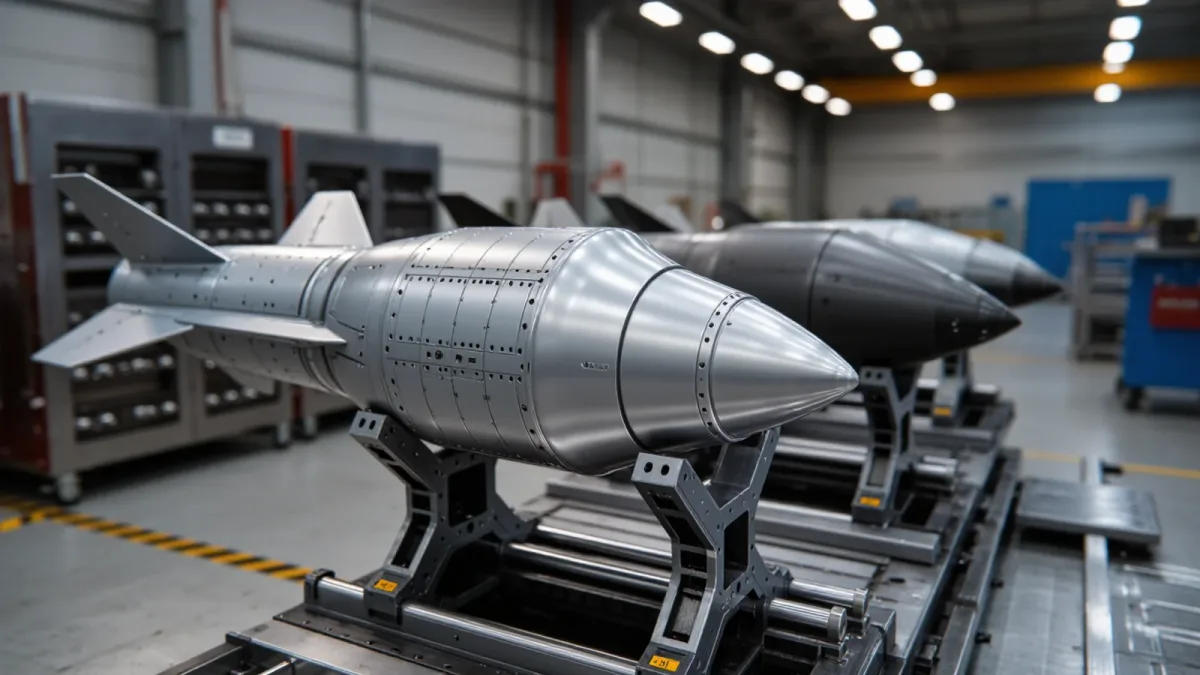
The Missile Defense Agency is pursuing Project Maverick, an effort to field an interim counter-hypersonic capability while the dedicated Glide Phase Interceptor remains in development, per DefenseScoop on May 11, 2026. The initiative acknowledges an uncomfortable gap: adversary hypersonic weapons are fielded today, while the purpose-built interceptor designed to defeat them in flight is not expected until the 2030s.
Why is there a hypersonic defense gap?
Hypersonic glide weapons are difficult to defend against because they fly along trajectories unlike traditional ballistic missiles. After boosting above the atmosphere, a glide vehicle descends and maneuvers toward its target inside the upper atmosphere, flying at speeds above Mach 5 while remaining unpredictable. Traditional missile defense architectures are built around predicting ballistic paths, and a maneuvering glide vehicle defeats much of that prediction logic.
The most vulnerable part of that flight is the glide phase, at altitudes of roughly 20 to 80 kilometers, per MDA descriptions. There the vehicle is slower than at apogee, its heat signature is bright from atmospheric friction, and an interception does not have to happen over someone else's territory. The Glide Phase Interceptor, or GPI, is the program designed specifically to hit in that regime.
What is Project Maverick?
Project Maverick, per DefenseScoop on May 11, 2026, is MDA's answer to the wait. Rather than leave the glide-phase problem unsolved until GPI fields, the agency is examining how existing and near-term interceptors, sensors, and fire control can be adapted to give combatant commanders some counter-hypersonic capability sooner. The interim nature is explicit: Maverick is meant to bridge capability, not replace GPI.
MDA Director Lt. Gen. Heath Collins told the Senate in April 2026 that GPI fielding is expected in the 2030s, per his testimony. That timeline, honest by development standards for a first-of-its-kind intercept regime, still leaves years during which regional commands have no dedicated glide-phase defense. Maverick exists to narrow that exposure window, drawing on the agency's accelerated acquisition authorities.
What does the sensor side look like?
Interception is only half the problem; tracking is the other. Glide vehicles fly low enough that ground-based radars lose them behind the horizon, so a counter-hypersonic architecture depends on space-based sensing that can see the vehicles continuously through their glide. The Pentagon has been developing a proliferated constellation of hypersonic-tracking satellites, including the SDA's tracking layer and MDA's Hypersonic and Ballistic Tracking Space Sensor, to provide the fire-control quality tracks an engagement requires.
Any Maverick capability will be coupled to that sensor build-out. The pairing matters because an interceptor without persistent tracking cannot engage a maneuvering glide vehicle at all, which is why the agency has framed counter-hypersonic defense as a system problem rather than a single weapon program, per MDA statements.
What should observers watch?
The markers to watch are Maverick's contract awards and demonstration milestones through 2026 and 2027, GPI's own development progress toward its 2030s fielding, per Lt. Gen. Collins' April 2026 Senate testimony, and the launch cadence of tracking satellites. The strategic clock is set by adversary deployments, which continue regardless of US development timelines, making the interim-versus-endgame distinction that defines Project Maverick, per DefenseScoop, the central fact of US counter-hypersonic policy this decade.
The acquisition mechanics differ too. Maverick is expected to use rapid prototyping authorities and commercial-style competition, per DefenseScoop on May 11, 2026, shortening the path from concept to demonstration. Whether that speed survives contact with intercept physics is the question the first demonstrations will answer.