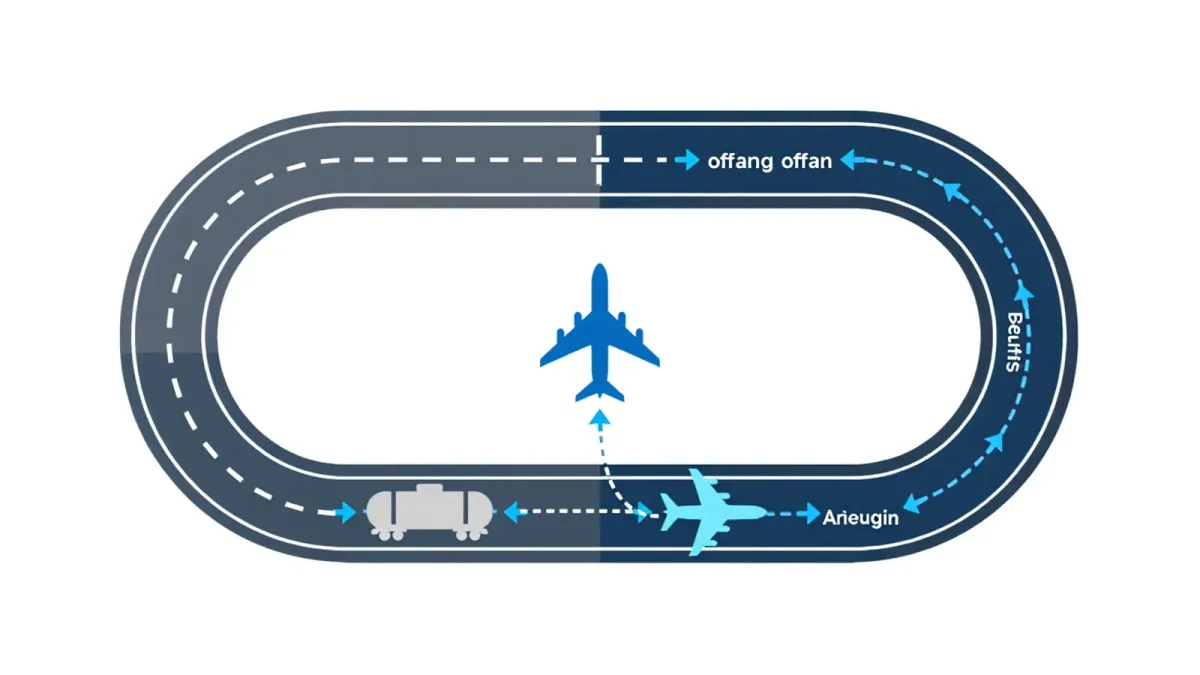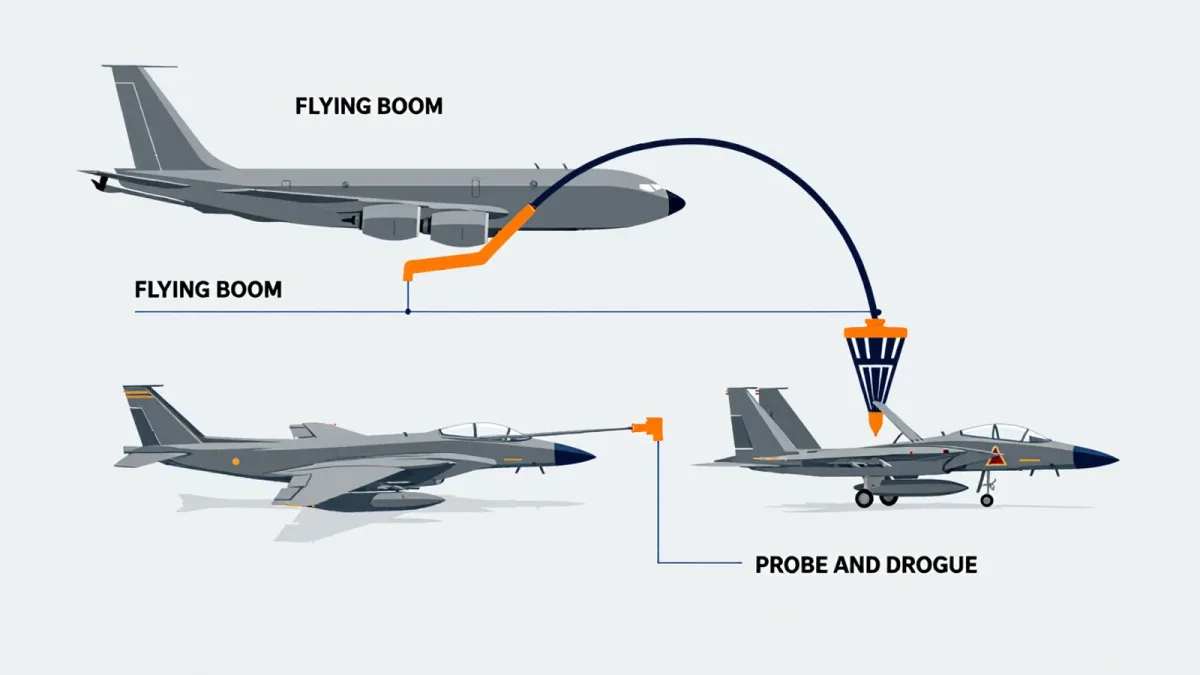
The United States refuels its combat fleet through two incompatible systems: the Air Force's flying boom, operated from dedicated tankers such as the KC-135 and KC-46, and the Navy-Marine method of probe and drogue, in which receiving aircraft fly their own probe into a hose trailed behind a tanker pod. The divide dates to the 1940s and still dictates which jets can top off from which tankers.
What is the difference between a boom and a drogue?
A flying boom is a rigid, telescoping tube controlled by an operator aboard the tanker, who steers it into a receptacle on the receiving aircraft's spine. Probe and drogue reverses the workload: the tanker unreels a flexible hose ending in a basket, and the receiving pilot flies the probe mounted on the aircraft's nose or wing into it.
The practical consequences follow directly. Boom systems move fuel far faster, with Boeing citing transfer rates above 1,000 gallons per minute for the KC-46's boom, while drogue systems typically deliver a fraction of that. Drogue hardware, by contrast, can hang from almost any tanker, including KC-130J Hercules and allied aircraft, which is why the Navy and most NATO partners standardized on it.
A short lineage
Probe and drogue descends from British work by Flight Refuelling Ltd in the late 1940s, and remains the method of choice for carrier aviation, where no boom operator aircraft can land. The flying boom was a Boeing development for the US Air Force, first fielded on KB-29 tankers in 1948, and it matured alongside the B-52 and jet fighter force, per Air Force historical accounts.
Why does the Air Force prefer the boom?
Throughput is the headline. Large bombers and cargo aircraft need tens of thousands of pounds of fuel per contact, and a rigid boom transfers it in minutes where a drogue would take far longer and demand a larger hose-drag formation. The boom's rigid connection also tolerates heavier aircraft and higher closure weights.
Centralized control is the second advantage. A trained boom operator, lying prone in the KC-135's tail or working the KC-46's Remote Vision System, manages the contact so fighter and bomber pilots simply hold position. That division of labor shapes Air Force training pipelines and crew standards, and it is why the service has resisted fleet-wide conversion to drogue-only tanking.
Why does the Navy stick with probe and drogue?
Nothing with a boom operator can land on a carrier, so naval aviation built its logistics around hose-and-drogue pods carried on tactical jets, the KC-130J and, increasingly, the CMV-22B and MQ-25. Every carrier-based aircraft carries a probe, which also lets Navy types refuel from allied tankers worldwide.
The cost is speed and workload. Drogue contacts put the flying burden on the receiving pilot, in turbulence, at night and in bad weather, and probe breakages remain a recurring maintenance item. The MQ-25 Stingray, whose first flight came in 2019 per Boeing, exists precisely to restore organic tanking to the carrier air wing without tying up Strike Hornets in buddy-store duty.
Bridging the gap
The two systems meet in dual-mission tankers. The KC-10 and KC-46 both carry a boom plus wing-mounted hose-and-drogue pods, and allied fleets such as the A330 MRTT offer boom or drogue configurations. Receptacle-equipped Air Force fighters can use drogue pods through adapters, but the compatibility is never total, and joint operations routinely require tankers positioned for both communities.
How old is the tanker fleet?
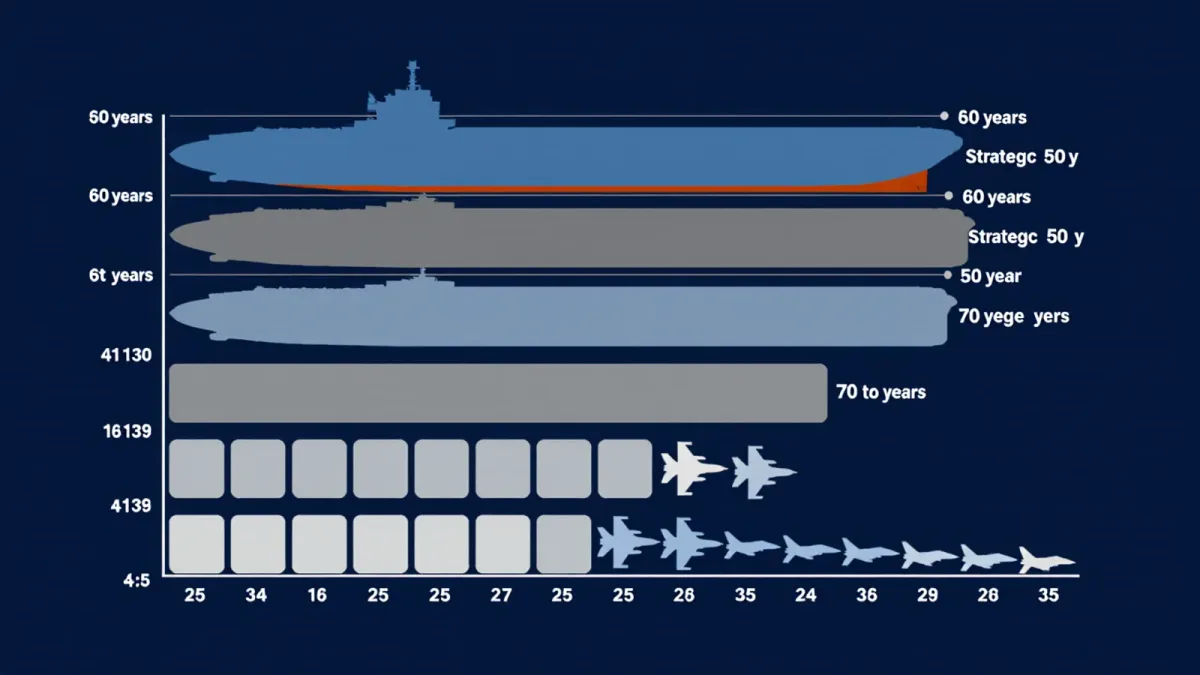
Old. The KC-135 entered service in 1957, and Air Force budget documents put the fleet's average airframe age at roughly 60 years, making it among the oldest combat-coded aircraft the service flies. The KC-10, the bridge between generations, was retired in September 2024, per the Air Force, leaving the KC-46 to carry more of the mission before the KC-Y next-generation tanker arrives.
The KC-46's own path has been rough. First delivered to the Air Force in January 2019, per Boeing, the aircraft has seen deliveries paused several times over defects in its remote vision system and cargo bay, fixes the company has worked through with the service. Each pause pushes fleet age upward and keeps KC-135 depot lines running.
What does the split cost in practice?
Compatibility drives tasking. A Navy strike package in a boom-only tanker region, or an Air Force bomber near drogue-only assets, cannot refuel regardless of what is overhead. Planners solve this with dual-capable tankers and pre-positioned pods, but the constraint shows up in every coalition exercise and in allied procurement debates over boom-equipped versus drogue-equipped MRTTs.
- Boom receivers: most large Air Force aircraft and receptacle-equipped fighters such as the F-16 and F-15.
- Drogue receivers: all carrier aviation, most Navy and Marine tactical jets, and the majority of allied fighters.
- Dual receivers: aircraft such as the F-35B/C, V-22 and allied fleets configured with probes, which can use drogue tankers anywhere.
What comes next for tanking?
The Air Force's next-generation tanker effort, KC-Y, remains shaped by the same physics: boom throughput for the strategic fleet, drogue capacity for everyone else. Whether the follow-on favors a larger boom-only airframe or a mixed fleet is the central question in the program's acquisition strategy, per Air Force statements, with the KC-135 replacement timeline stretching into the 2030s.
Autonomy may blur the line before then. The Navy's MQ-25 and Air Force experiments with optionally crewed tankers point toward drogue operations that do not consume a tactical jet, while boom work remains operator-centric. The 1940s-era split, however, still defines who can refuel whom.
How do crews train for each method?
Boom operators train on dedicated schoolhouse syllabi and simulator devices that replicate the tail position and the remote vision system, then qualify in aircraft across receiver types. Drogue skills live with the receiving pilots, who practice basket contacts in simulators and airborne profiles before they ever need fuel over water.
The training split explains each community's instincts. Air Force tanking culture centers on the operator's judgment of closure rate and receiver stability, while naval aviators own their own contacts in turbulence and at night, on treatments that compress the learning curve. Neither skill transfers cleanly across the divide, which is why cross-community exchanges remain a recurring topic in readiness discussions.
Weather and night effects
Both methods degrade in bad weather, but differently. The boom's rigid connection gives the operator authority to fly the contact through gusts, while a drogue and hose whip in turbulence and can exceed probe load limits, driving naval tanking minimums higher. Night operations lean heavily on illumination and, on the KC-46, the remote vision system whose defects shaped the aircraft's early years, per Air Force and Boeing statements.
What should a reader watch next?
Two milestones will define the decade. The KC-Y award will set how quickly the 1950s-vintage boom fleet retires, and MQ-25 fielding will show whether unmanned drogue tanking can carry a carrier air wing's daily fuel demand. Both programs are answerable to the same constraint the 1940s inventors faced: fuel delivered per minute, per contact, per tanker.
The split also survives because it works. Sixty years of KC-135 operations, carrier tanking through every conflict since Korea and the dual-method tankers bridging both communities have produced the densest aerial refueling enterprise in the world. Compatibility tables, adapters and dual-mission airframes manage the friction; the physics set in the 1940s sets the shape.