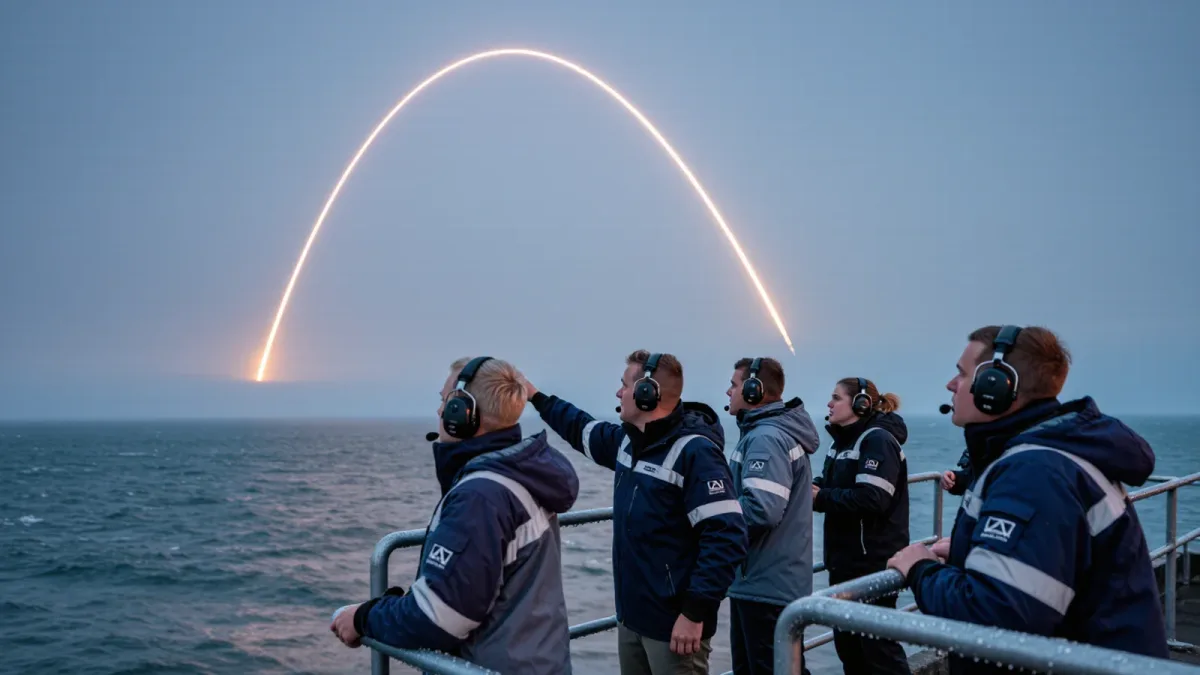
Through the end of 2025, the only US hypersonic glide-vehicle flight tests with public confirmation trace to one hardware line: the common hypersonic glide body, or C-HGB. The Missile Defense Agency and the Army announced a successful full-system LRHW missile flight in December 2024 and a second in March 2025, the first end-to-end tests of the weapon the Army fields as Dark Eagle. Everything earlier was component work, glide-body-only shots, or silence.
That gap between what flew and what was implied has defined the American hypersonic effort for a decade. Here is the public record, test by test, and where the claims outrun it.
What is the common hypersonic glide body?
The C-HGB is a cone-shaped, rocket-boosted glide vehicle developed jointly by the Navy, the Army and the national laboratories, built so one airframe serves both services. The Navy's version flies inside the Conventional Prompt Strike, or CPS, weapon; the Army's wraps the same glide body in the Long-Range Hypersonic Weapon, LRHW, fielded as Dark Eagle.
The design draws on glide-body work the laboratories ran through the 2000s and 2010s. The Pentagon and its partners flew the C-HGB from the Pacific Spaceport Complex in Kodiak, Alaska, in October 2019 and again in October 2020, with the Department of Defense announcing both as successful. Those were glide-body characterization shots: no full operational launcher, no full missile, no warhead-representative hardware. They proved the vehicle could boost, separate and glide. They did not field a weapon.
The services are deliberately quiet about glide-body performance numbers. The Army's most specific public range statement, repeated in budget testimony, is that LRHW reaches well beyond 1,725 kilometers. No public source gives an official speed figure beyond the generic claim that the weapon sustains hypersonic speeds, generally understood in these programs to mean flight above Mach 5.
What has actually flown under the LRHW program?
Three things, in escalating order. First, the glide-body shots at Kodiak in 2019 and 2020. Second, in March 2023, the Army announced a successful static fire of the first-stage solid rocket motor for LRHW at Hill Air Force Base in Utah, the first time a complete first stage fired on a test stand. Third, in December 2024, the Missile Defense Agency and the Army flew the first full missile, and followed it with a second full-system flight in March 2025, both announced as successful.
The Army formed the first LRHW battery, part of the 5th Battalion, 3rd Field Artillery Regiment under the 17th Field Artillery Brigade at Joint Base Lewis-McChord in Washington, and built the hardware through multi-year prototypes. Army leadership has said publicly that the unit received prototype launchers, fire control and training hardware before the December 2024 flight. Fielding of operationally fielded rounds, rather than test assets, is planned later this decade per Army budget documents.
So the honest ledger reads: glide body proven 2019 to 2020, first stage proven 2023, full missile proven December 2024. Dark Eagle was a training-load battery for most of that period, not a combat-loaded one.
What about the Navy's Conventional Prompt Strike?
CPS shares the glide body and much of the missile stack. The Navy's first carrier was supposed to be the converted Ohio-class submarine USS Illinois, with the payload tubes deferred; the program later shifted the first at-sea deployment to the Zumwalt-class destroyer, and the Navy has said in budget documents that CPS installation aboard USS Zumwalt is underway, with fielding planned later this decade. No CPS flight from a Navy platform had been publicly announced through the end of 2025.
That makes the Navy line thinner than the Army's on paper. The shared glide body de-risks part of it, but Cold Launch tubes, shipboard fire control and the Zumwalt conversion all remain steps the service has not yet demonstrated in public.
What do the earlier failures on record show?
The American glide-vehicle ledger includes high-profile losses, and they still shape the program's caution. DARPA's HTV-2 slid into the Pacific during its second flight in August 2011 after roughly three minutes of glide, cut short by flight anomalies. In November 2014, the Army's Advanced Hypersonic Weapon, a C-HGB ancestor, was destroyed about four seconds after launch at Kodiak when its booster failed.
Both failures were booster or early-flight events rather than glide losses, a distinction the program offices repeatedly make. It is accurate but incomplete: the harder truth in the public record is how few full-vehicle shots exist at all. The US flew a handful of publicly acknowledged glide tests in the 2010s while press releases promised operational weapons within a few years. None arrived on schedule.
How do US claims compare with what rivals have shown?
Russia fielded the Avangard glide vehicle atop ICBMs, per its own statements, and the Kinzhal air-launched missile, which Western analysts classify as a quasi-ballistic system rather than a true glide vehicle. China displayed the DF-17 with a glide vehicle at its 2019 parade and flew a fractional orbital bombardment test in July 2021, per reporting by the Financial Times based on US intelligence assessments. Those are the comparisons Pentagon testimony cites when asking Congress for LRHW and CPS funding.
US officials generally stopped quoting timelines after the slips of the late 2010s. The current framing, from MDA and Army statements since the December 2024 flight, is quieter: a weapon is entering the force at the pace the test record supports.
What remains unproven in public?
Several load-bearing claims still rest on assertion rather than open demonstration. No US shot has been announced with an operational launcher moving to a field site, firing and displacing, which is the skill that matters for the Army's Pacific mission. End-to-end shots with seekers and maneuver-accuracy data remain classified, so reported success is a pass-fail announcement, not published accuracy. Production rate is unproven: the C-HGB production line and its industrial base were cited in Pentagon testimony as a scaling concern. And no CPS shot from a Navy ship had been announced through late 2025.
For procurement audiences, the December 2024 and March 2025 flights move hypersonic strike from aspiration to demonstrated hardware. What they do not yet demonstrate is an arsenal.
Frequently Asked Questions
What is the range of the Dark Eagle missile?
The Army has said publicly that LRHW can strike targets at ranges well beyond 1,725 kilometers, roughly 1,000 nautical miles. No official maximum range has been published, and the service has not released speed or accuracy figures. Anything more specific than the 1,725-kilometer floor comes from analysis, not from the program office.
Has the LRHW Dark Eagle been used in combat?
No. As of the end of 2025, the Army had announced no combat use of LRHW. The first battery holds prototype hardware at Joint Base Lewis-McChord, and the program's milestones through 2025 were flight tests: the December 2024 and March 2025 full-missile shots announced by the Missile Defense Agency and the Army.
What is the difference between a hypersonic glide vehicle and a ballistic missile?
A ballistic missile follows a predictable arc set by its boost phase. A glide vehicle is boosted to high speed and altitude, then flies an unpowered, lifting trajectory through the upper atmosphere, maneuvering en route. That maneuvering, at speeds above Mach 5, is what complicates both tracking and interception, and it is the reason MDA and the Space Force describe hypersonic defense as a distinct tracking problem.
Which services use the common hypersonic glide body?
Both the Army and the Navy. The Army fields it in the Long-Range Hypersonic Weapon, Dark Eagle, launched from trucks assigned to the 17th Field Artillery Brigade. The Navy packages it in Conventional Prompt Strike for surface ships and, eventually, submarine tubes. One airframe, two service programs, a deliberate industrial-base decision per Pentagon statements.
Did any US hypersonic tests fail that the public knows about?
Yes. DARPA's HTV-2 lost contact and crashed during its second flight in August 2011 after about three minutes of glide. The Army's Advanced Hypersonic Weapon was destroyed roughly four seconds after launch from Kodiak in November 2014 due to a booster failure. Both are acknowledged in program history, and both involved boost or early-flight problems rather than the glide phase itself.