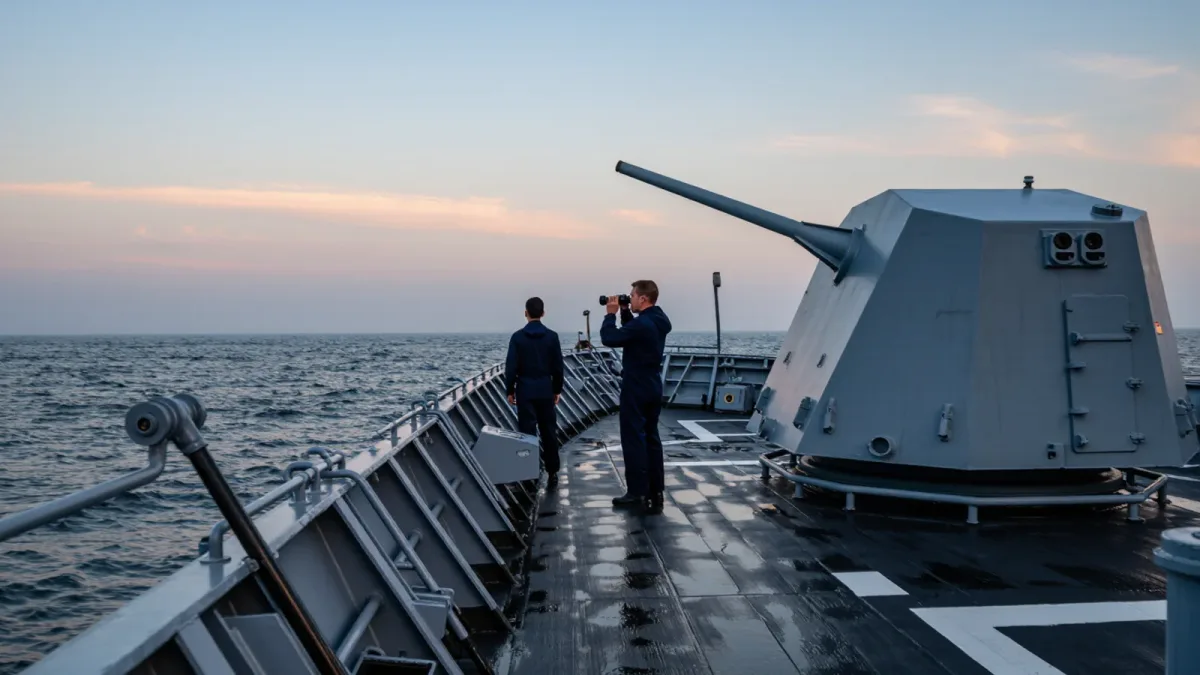
The Navy's HELIOS program put a 60-kilowatt-class laser aboard the destroyer USS Preble, the first high-energy laser fielded on a US surface combatant, with the ship operating in the Pacific from 2024, per Navy announcements. Sixty kilowatts defeats small drones, boats and sensors with seconds of dwell time on target. The threshold for the missions sailors actually fear, larger one-way attack drones and subsonic cruise missiles, sits around 300 kilowatts, where dwell times compress from seconds toward a fraction of a second and the atmosphere stops eating the kill. That gap between what is fielded and what is required defines the current laser market.
The Army runs a parallel track, with 50-kilowatt lasers on Strykers since 2022 and a 300-kilowatt-class Indirect Fire Protection Capability effort underway. Both services are converging on the same scaling problem.
What is HELIOS, and what can it do today?
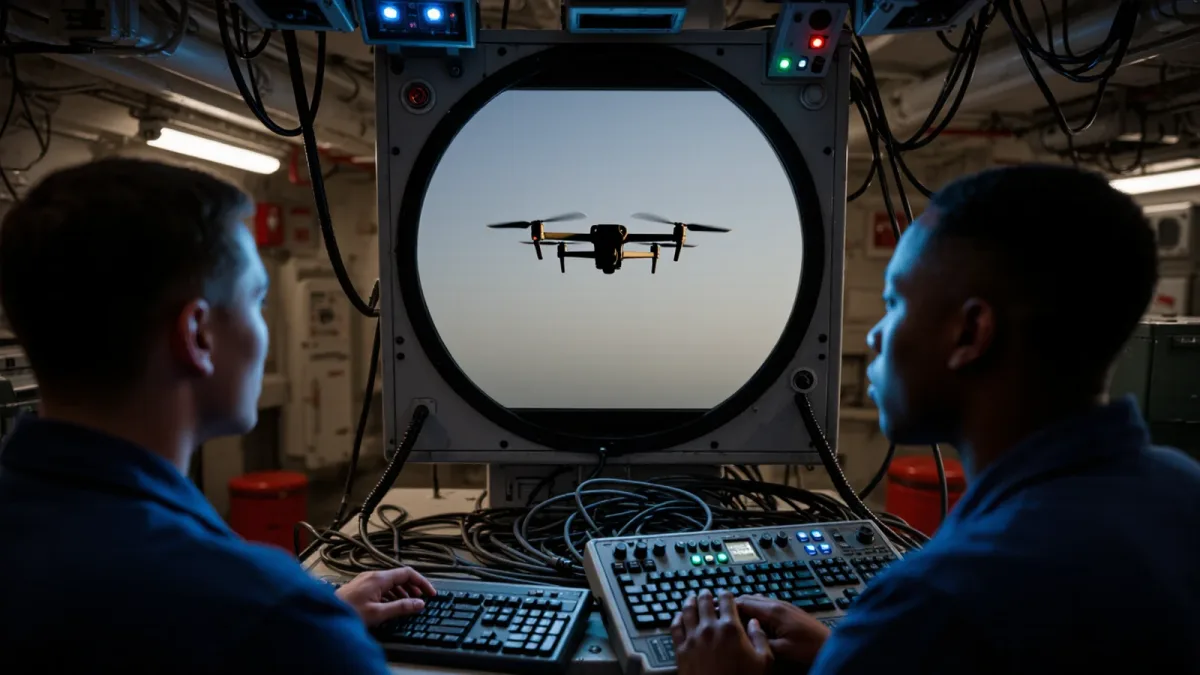
HELIOS, the High Energy Laser with Integrated Optical-dazzler and Surveillance system, is a Lockheed Martin-built system the Navy contracted for in 2018 and delivered beginning in 2021. It integrates a 60-kilowatt-class laser with an optical dazzler to defeat drone and sensor threats, and its power feeds into the ship's own electrical grid architecture aboard Arleigh Burke-class destroyers. The Navy announced successful tests against targets, and USS Preble sailed with the system operational in the Pacific in 2024.
Two features matter beyond raw power. First, integration: HELIOS draws shipboard power rather than carrying its own generation, which makes it a repeatable installation rather than a one-off demonstration. Second, its deep-magazine economics: per Navy officials, a laser engagement costs roughly the electricity to fire it, and the magazine empties only when the ship runs out of power or cooling, not rounds.
Why is 300 kilowatts the number that matters?
Because defeating a hardened target is about energy delivered on it, and energy is power multiplied by dwell time. A 60-kilowatt beam needs seconds on a Group 3 drone, an eternity if a swarm is arriving from multiple axes or the target is maneuvering. At 300 kilowatts, the same defeat takes a fraction of the time, letting one aperture engage multiple targets in a raid and reach target classes, larger airframes and subsonic cruise missiles with thermal endgame kills, that 60 kilowatts cannot credibly burn through.
The Navy has framed 150 to 300 kilowatts as the class relevant to cruise missile defense in program materials, and its 300-kilowatt ambitions have been stated publicly since the early 2020s. Army requirements mirror it: the Indirect Fire Protection Capability High Energy Laser effort contracted a 300-kilowatt-class system from Lockheed Martin in December 2022 to defend fixed sites against drones, rockets and cruise missiles.
What stands between 60 and 300 kilowatts?
Three engineering walls, none theoretical. Power and cooling: a 300-kilowatt laser demands roughly five times the electrical and thermal management of a 60-kilowatt system, and on a destroyer that competes with radar and combat system loads. Beam quality: scaling diode-pumped sources tends to degrade the beam, and a poor beam wastes power exactly when the program cannot afford to. The atmosphere: humidity, salt aerosol and turbulence attenuate and distort the beam, so a laser that works in a desert test range underperforms at sea until adaptive optics catch up.
Then there is the engagement problem: a laser needs dwell, meaning it must hold the beam steady while the target flies, and against sea-skimming missiles closing at 500 knots the geometry window shrinks with every kilometer of range. That is why the services describe lasers as one effector in a layered defense, alongside interceptors and guns, rather than a replacement for them.
What is the Army fielding meanwhile?
The Army took the near-term path: smaller lasers on wheeled vehicles against the threats it actually meets. The Directed Energy Maneuver-Short Range Air Defense system, a Raytheon-built 50-kilowatt laser on a Stryker chassis, began fielding to an Army brigade from 2022. The Army also deployed prototype P-HEL systems, based on BlueHalo's LOCUST laser, to US Central Command beginning in 2023 for counter-drone duty, per Army statements.
The division of labor is explicit: 50-kilowatt systems handle quadcopters and small drones at close range; the 300-kilowatt IFPC-HEL class is meant for the cruise-missile problem from fixed sites. Both feed the same scaling lessons the Navy is learning aboard Preble, and both services brief progress against the same three walls: power, beam quality and atmosphere.
Do lasers really cut cost per kill?
Per engagement, yes, dramatically: service officials consistently describe laser shots as costing roughly the price of the electricity consumed, against interceptor prices from tens of thousands to millions of dollars. Red Sea operations in 2023 and 2024, where US forces spent interceptors on cheap drones, sharpened the argument. The honest caveat is the system price: a fielded 300-kilowatt installation carries its own development, integration and maintenance costs, so the economics work only where raids are frequent enough to amortize them. That describes naval escort missions and fixed-site defense, which is precisely where both services have aimed.
How do testers measure whether a laser works?
Laser lethality testing is energy accounting. Engineers characterize a target's vulnerability in joules per square centimeter, the fluence needed to burn through skin, damage optics or initiate a warhead, then measure what the system actually delivers at range after atmospheric losses and beam-quality degradation. Tests against drones at White Sands and naval ranges through the 2020s followed that method, and the Navy reported HELIOS engagements against targets at sea consistent with its 60-kilowatt class, per service releases. Two measurement subtleties matter for buyers. First, published kilowatt ratings are source power, not delivered power: a system that loses half its beam quality in humid air performs at half its label. Second, lethality is a probability curve, not a switch: dwell time, target aspect and weather move the required engagement time, which is why programs report both power and effective range. Any vendor claim quoted without delivered-fluence context deserves skepticism.
Frequently Asked Questions
What is the Navy's HELIOS laser?
HELIOS, the High Energy Laser with Integrated Optical-dazzler and Surveillance system, is a Lockheed Martin-built 60-kilowatt-class laser delivered to the Navy from 2021 and installed aboard the destroyer USS Preble, which operated it in the Pacific from 2024, per Navy announcements. It defeats small drones and boats and dazzles enemy sensors, drawing power from the ship's grid.
What laser power is needed to shoot down a cruise missile?
Service program materials point to the 150 to 300 kilowatt class as the threshold for subsonic cruise missile defense, with 300 kilowatts providing dwell times short enough for raid-sized engagements. Below that, beams can defeat drones and boats but lack the energy on target to destroy hardened, fast-moving airframes reliably within the engagement window.
Why do lasers struggle at sea?
The atmosphere. Humidity, salt aerosols and turbulence absorb and distort the beam, cutting effective power and forcing longer dwell times, which is why desert test results overstate maritime performance until adaptive optics compensate. Ship motion and power sharing with radar and combat systems add integration constraints unique to surface combatants.
What laser systems does the Army field?
The Army has fielded 50-kilowatt lasers on Stryker vehicles under the Directed Energy Maneuver-Short Range Air Defense program beginning in 2022 and deployed P-HEL prototype systems, based on BlueHalo hardware, to Central Command from 2023 for counter-drone duty, per Army statements. Its 300-kilowatt-class IFPC high-energy laser effort, contracted to Lockheed Martin in December 2022, targets fixed-site defense against drones, rockets and cruise missiles.