The US solid rocket motor industry has exactly two significant producers: Northrop Grumman, which absorbed Orbital ATK in 2018, and L3Harris, which acquired Aerojet Rocketdyne in 2023 after a contested bidding process. Every strategic missile, most tactical missiles, and the boost stages of many interceptors trace to one of those two houses, per the companies' own program disclosures, and per GAO reviews of munitions industrial base capacity, both entered the 2020s expansion cycle from decades-low production rates. The structure is a case study in what the Pentagon calls a critical narrow supplier: a market too small to attract new entrants under normal conditions, too important to leave fragile.
How did the industry end up with two producers?
The path runs through the same consolidation waves that shaped the rest of the sector. Aerojet and Hercules/Thiokol and Atlantic Research once gave the market four or more participants; per the corporate histories of the firms involved, exits and mergers in the 1990s-2000s thinned the field. Orbital ATK — the 2015 merger of Orbital Sciences with Alliant Techsystems' aerospace business — consolidated one camp, and Northrop Grumman's $9.2 billion acquisition of it in 2018, per the companies' announcements, brought motors in-house to the nation's largest missile prime. L3Harris's $4.7 billion purchase of Aerojet Rocketdyne, completed in July 2023, followed a rejected earlier bid by Lockheed Martin that antitrust reviewers had scrutinized, per Justice Department statements at the time. The department's public position across both transactions was consistent: it wanted the capacity inside financially strong owners, and it accepted the duopoly that remained.
Why is capacity so hard to expand?
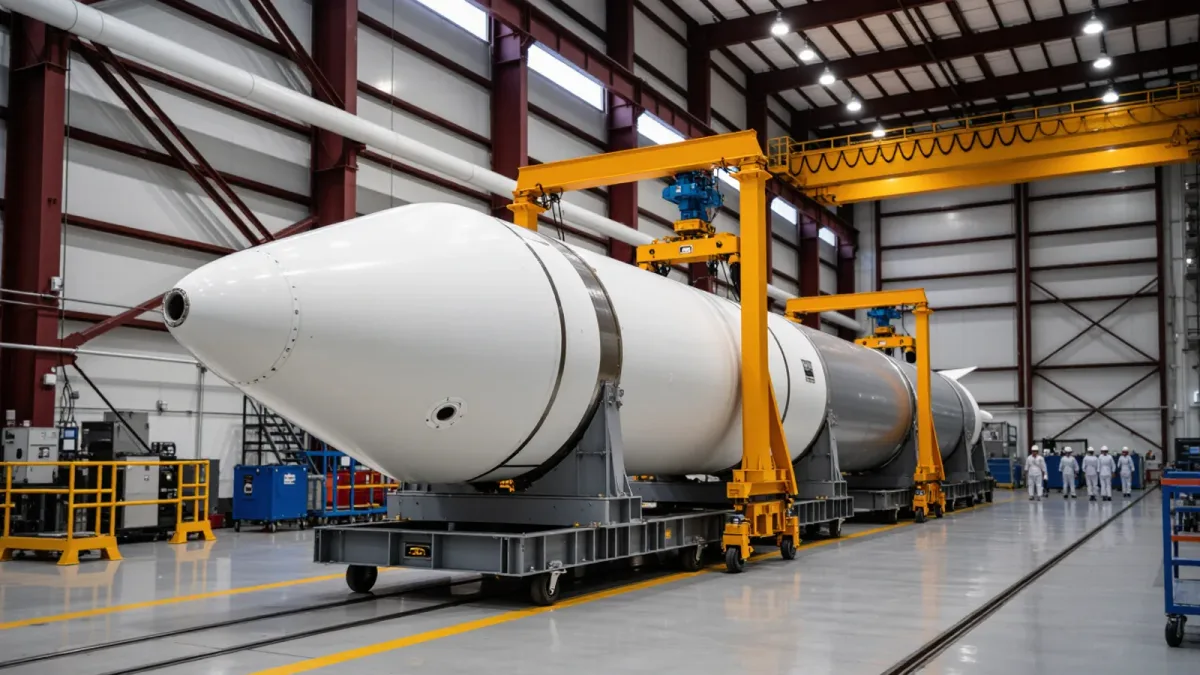
Solid motors are, in the literal sense, grown rather than assembled: propellant is cast into cases and cures under controlled conditions over weeks, and per the companies' published descriptions, a new production line takes years to bring online because ingredient supply, mixing capacity, casting pits, and ballistic qualification all scale together. Ingredients concentrate the fragility further — per GAO and DoD industrial-base reports, ammonium perchlorate, the oxidizer at the core of nearly all US solid propellant, is produced domestically at effectively single-source scale. Static test infrastructure adds another gate: every new motor design and every periodic lot acceptance requires firing at a limited set of national test stands, and per the department's own assessments, test-slot availability has constrained qualification timelines in past surge periods. Each element is individually manageable; together they mean demand growth translates into capacity only on a multi-year clock.
What drove the current demand surge?
Three demand streams converged after 2021. Strategic modernization: per the Air Force's program materials, the Sentinel ICBM program and the Columbia-class submarine's strategic weapons requirement added large-motor demand with fixed schedule positions. Tactical consumption: the munitions expended in Ukraine and, from 2023, in Middle East operations — per DoD replenishment announcements — drove multi-year orders for motors behind the GMLRS, Javelin, Stinger, and AMRAAM families. And missile defense: per MDA procurement statements, interceptor production rates rose to support the expanding threat set. Per the companies' earnings disclosures through 2024-2025, both houses reported record backlogs and announced capacity expansions — new mixing and casting capacity, ingredient onshoring, and workforce programs — funded by customer advances and direct industrial-base investment. Per GAO reviews, the expansions address real bottlenecks but mature on 2025-2027 timelines at the earliest.
What are the risks of a duopoly under load?
The classic risks concentrate rather than diversify. A single incident — a fire, an explosion, a quality escape — at one house interrupts a large share of national motor supply, and the record shows such events: per public reporting on past industry incidents, propellant facility accidents have repeatedly taken capacity offline for extended periods. Price risk follows structure: with two qualified sources, competition exists at contract level but not at depth, and per GAO's procurement reviews, sole-source positions within either house's product line are common because motors qualify to specific missiles. Schedule risk ties the whole missile enterprise to the same two queues — per GAO's annual weapons assessments, motor delivery delays have propagated into missile program slips across multiple portfolios in the 2020s. The department's mitigation is the one available: fund both houses, add ingredient and test capacity as shared infrastructure, and accept that the market structure itself is policy.
Could new entrants change the structure?
What did the contested Aerojet sale decide?
The 2021-2023 fight over Aerojet Rocketdyne settles the question of how the government views this industry's structure. Lockheed Martin agreed to buy the company for $4.4 billion in December 2020; per the Justice Department's January 2022 announcement, it sued to block the deal, arguing that vertical integration — the nation's largest missile prime owning the motors inside missiles it would sell against competitors — would let it disadvantage rival primes that depended on Aerojet motors. The deal died, and L3Harris's competing cash offer prevailed at $4.7 billion, closing in July 2023 as a horizontal transfer from one independent owner to another. Per the department's public statements and subsequent contracting behavior, the outcome preserved the two-house structure and the arms-length motor market that competitors such as Raytheon and Boeing depend on — a decision about market structure dressed as an antitrust filing, and the clearest statement of policy the sector has received: the duopoly stands, but its independence is the protected feature.
How do the motor houses fit inside their new parents?
Both acquisitions moved the motor makers inside conglomerates with their own portfolio logic, and the fit differs. Per Northrop's announcements, the former Orbital ATK propulsion business sits alongside the company's missile and strategic franchises — Sentinel, GBSD-era work, interceptor boosters — making it largely captive supply inside one prime. Per L3Harris's disclosures, Aerojet Rocketdyne kept its brand and merchant posture, selling to the primes that Northrop's motor house cannot serve without arms-length friction — the position the Justice Department's block of the Lockheed deal was designed to preserve. The structural consequence is asymmetry: per the companies' earnings reporting, one house's motor demand is substantially internal and schedule-driven; the other's is external and market-driven. For customers, the practical question each procurement asks is which house, which queue, and what the arms-length terms are — and per contract patterns of 2024-2025, prime competitors increasingly negotiated long-term supply agreements to lock their position in the merchant house's backlog before the demand surge consumed it.
Entrants exist at the edges and have not reached the core. Per the startup sector's public record, several new-space and new-defense firms have demonstrated solid or hybrid motors at small scales, and per Air Force and DIU announcements, prototype programs have funded alternative propellant approaches. The barrier is not proof of concept but qualification economics: a strategic- or tactical-class motor requires years of ballistic qualification against a specific missile, and per the department's own contracting practice, no customer will fund that qualification without a production commitment — the classic chicken-and-egg that keeps the two-house structure stable. What new entrants have changed is the marginal calculus: per contract announcements, small-motor categories now see competitive tension that did not exist in 2015, and per the incumbents' own investment decisions, the duopoly behaves less comfortably than its structure would predict.
What should watchers track?
Four indicators compress the industry into a monitorable set. Facility announcements from the two houses — mixing, casting, and ingredient capacity — signal where the queue is widening. GAO's annual weapons and industrial-base reports document delivery delays and their program consequences. DoD industrial-base investment lines show where the department is adding shared infrastructure — oxidizer production, test stands — rather than relying on the two houses alone. And per the market's own signals, any acquisition or capacity entry in the ingredient tier matters more than headline motor contracts, because the deepest chokepoints are one and two layers below the motor houses themselves. On present plans, per company and DoD statements, capacity roughly tracks demand by the late 2020s — with the caveat, written across the sector's own history, that demand forecasts have a record of their own.