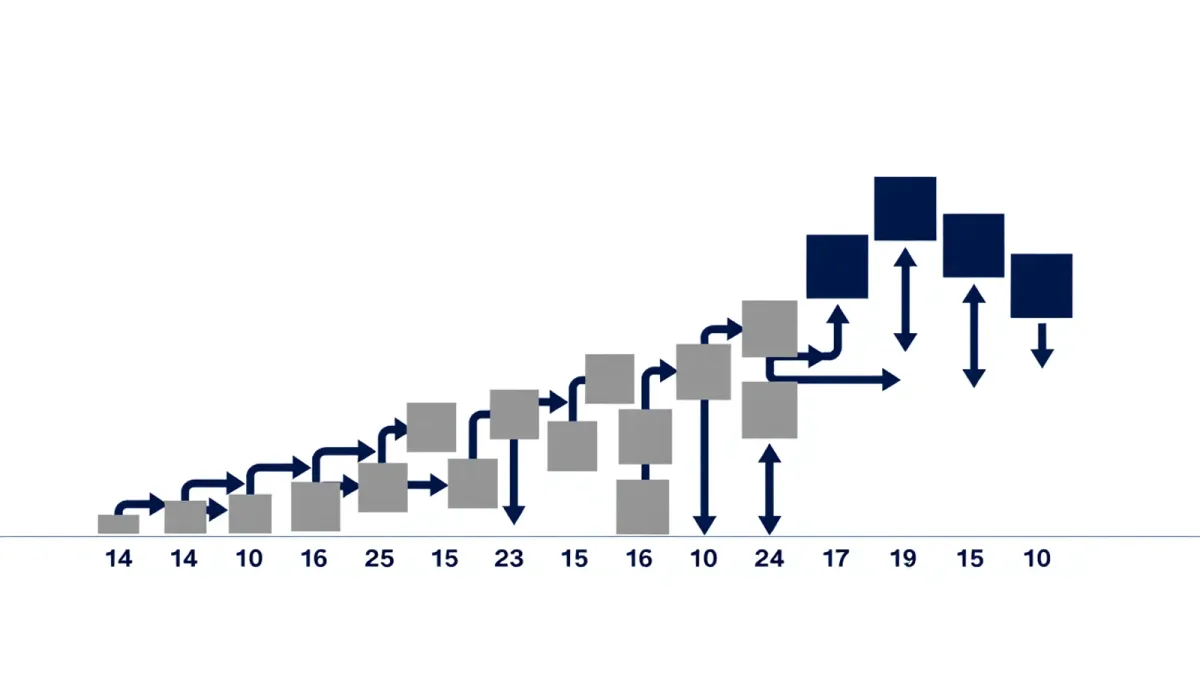
In 1993 the United States had 51 companies qualifying as aerospace and defense primes; a decade later there were five of consequential scale — a consolidation MEMA's famous Pentagon briefing slide turned into an era. The process, driven by post-Cold War budget decline and actively encouraged by defense officials, produced Lockheed Martin, Boeing's defense empire, Northrop Grumman, RTX, and General Dynamics in roughly their modern forms. Every structural argument in defense industry policy today — prime concentration, supplier-base fragility, startup disruption — starts from that contraction and its consequences as documented in DoD's own industrial-base assessments.
What started the merger wave?
The trigger was arithmetic. Defense procurement dollars fell roughly by half between the mid-1980s and mid-1990s per DoD budget data, leaving more airframe and electronics houses than the market could feed. The famous mechanism was a 1993 dinner — the “Last Supper” — where Pentagon acquisition officials told industry executives that consolidation was expected and that the department would not stand in the way, an account confirmed in later DoD oral histories. The government then paid merger costs: per statutory provisions of the era, restructuring expenses from approved defense mergers could be charged into contracts, a subsidy for consolidation unique to the sector.
Which mergers created today's primes?
The decisive combinations came in the 1990s. Lockheed merged with Martin Marietta in 1995 and absorbed General Dynamics' fighter and missile units and Loral's electronics, becoming the largest defense company on earth. Boeing bought McDonnell Douglas in 1997, ending St. Louis's run as an independent prime and concentrating the commercial-duopoly and defense franchises in one house. Northrop merged with Grumman in 1994 and later bought Litton, Newport News, and Westinghouse's electronic businesses. Raytheon consolidated with Texas Instruments' and Hughes' defense electronics, the predecessor of today's RTX after the 2020 United Technologies merger. General Dynamics sold its fighter and missile lines and rebuilt around shipbuilding, land systems, and IT — the shaper, not the shaped. Per the companies' own merger histories, those combinations closed between 1993 and 2001, with a second, quieter wave after 2018: Northrop's purchase of Orbital ATK, L3Harris's of Aerojet Rocketdyne in 2023, and RTX's formation.
What did consolidation do to prices and innovation?
The evidence is mixed and contested. Per the Pentagon's own antitrust-relevant statements and studies cited in its industrial-base reports, the wave reduced the number of bidders on major programs — several large competitions of the 1990s drew six or seven primes; their 2010s successors drew two or three. Sustainment and sole-source concerns rose correspondingly: GAO has documented single-bidder conditions on significant contract portfolios. On innovation, defenders of consolidation argue that scale funded the J-79-to-F135 lineage and integrated stealth development; critics counter that the startup wave of the 2010s-2020s — autonomous systems, launch, software — came precisely from outside the consolidated primes. Per DoD's 2023 National Defense Industrial Strategy, the department now treats a ”diverse supplier base” as a policy goal, an explicit judgment that the contraction overshot.
Why hasn't a new prime emerged?
Barriers are structural. A modern prime needs security-cleared infrastructure, classified program experience, and past performance records that government source selections weigh heavily — none purchasable quickly. Per annual 10-K risk disclosures, the largest programs carry decade-long development cycles that only firms with diversified cash flow can survive. Regulatory posture also shifted: after the 1990s, the Pentagon's antitrust reviews of further mega-combinations — the 2024 blocked attempted combination in the aerospace supplier space being a recent example per the department's public statements — have been skeptical of reducing bidder counts further. New entrants scale to ”new prime” status from below: per company disclosures, the newest firms with multi-billion-dollar backlogs grew through autonomy, munitions, and software rather than classic airframe integration.
What does the history suggest for today's market?
What happened to the suppliers under the merged primes?
Consolidation did not stop at the top. The merchant supplier base — companies selling to multiple primes rather than to the government — contracted in parallel, per the Pentagon's industrial-base assessments, as post-merger purchasing consolidation concentrated orders. Divestitures accompanied the big combinations: to clear antitrust review of the Lockheed-Martin Marietta merger, the companies divested major lines, and those carved-out businesses became the seed of several independent mid-tier suppliers still active today. The 1990s also settled the fate of the second-tier aircraft makers — Vought, Rockwell's defense units, and Grumman's airframe business — which disappeared into the primes rather than persisting as independents. Per GAO's later reviews, the result was fewer bidders at both levels, with the merchant-tier contraction showing up in subsequent decades as the sole-source fragility the department now funds programs to fix.
Did consolidation deliver the savings it promised?
The record is contested in the government's own documents. Pentagon officials of the era argued that mergers would cut overhead and preserve critical scale at lower cost to the taxpayer, and merger savings were cited in the contract-restructuring approvals that let companies bill reorganization costs to the government. GAO examined those claims repeatedly and found the savings estimates unverified — per its reports, the department did not track realized merger savings against projections in a way that would let Congress audit the promise. What the record does show clearly are the costs the era did not forecast: reduced competition on future programs, higher sole-source shares in the following decades, and the strategic fragility documented in the department's later industrial-base reports. The policy lesson the National Defense Industrial Strategy draws — that a wider supplier base is worth subsidizing — is effectively a correction of the 1990s bet, made with the benefit of its results in evidence.
How does the 1990s experience read into today's startup wave?
The newest entrants are the consolidation wave's mirror image. Where the 1990s merged airframers to preserve scale, the 2010s-2020s built firms around autonomy, software, and new manufacturing methods that the consolidated primes had underweighted, per the business models those startups published. Their scaling path differs from the old prime path too: rather than absorbing competitors, the largest new entrants have grown single product families to multi-billion backlogs, per company disclosures, and partnered with primes where legacy platforms require it. The question the consolidation history poses for this wave is the same one the Last Supper era answered differently: when budgets tighten again, does the government prefer scale or diversity? The National Defense Industrial Strategy has staked out diversity; the 1990s record warns that preference can reverse within a single budget cycle.
Two lessons recur. First, industry structure follows budgets with a lag: the contraction of the 1990s answered the budgets of 1991-1995, and the expansion debates of the 2020s answer the budget growth of 2022-2026. Second, the government is not a bystander — it subsidized the 1990s mergers through contract treatment, and it now subsidizes diversification through supplier-base programs, per the National Defense Industrial Strategy's own text. The consolidated primes remain the system's backbone; the strategy documents and the startup ecosystem's growth both concede the backbone alone no longer spans what the department needs built. Watch merger filings, not earnings calls, for the next structural chapter: the 1990s taught that when the Pentagon tells industry what structure it prefers, industry consolidates accordingly.