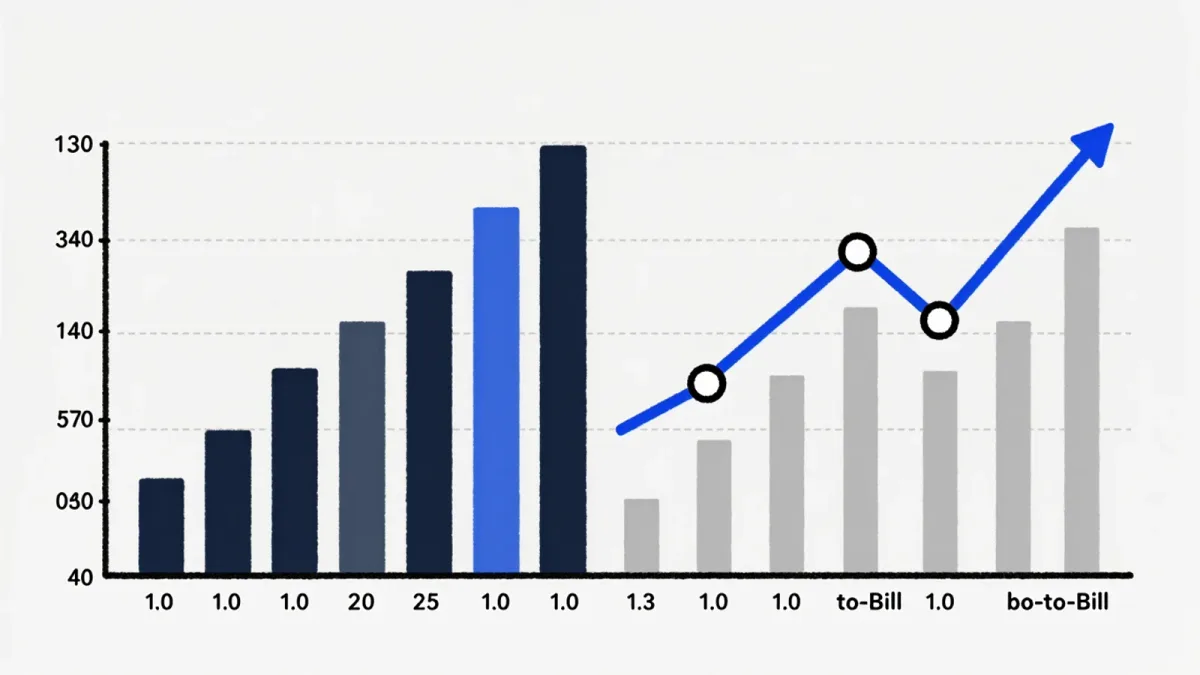
Book-to-bill — new orders divided by revenue in a period — is the single most-watched ratio in defense earnings reporting because it answers the question revenue cannot: whether the business is growing into its future. A ratio above 1.0 means a contractor booked more than it billed, accumulating backlog; below 1.0, it is consuming its order book. Per the largest contractors' quarterly disclosures through 2024-2025, sustained ratios above one across the sector reflected the rearmament cycle, with company-reported backlogs at all-time highs — figures that translate directly into multi-year production visibility for primes and their supplier tiers.
What exactly do the metrics measure?
Bookings are the value of contract awards and modifications received in the period; revenue is what the company recognized as earned. Backlog is the sum of awarded but unearned work, and the split inside it matters: funded backlog carries appropriated money behind it and can be billed as work proceeds, while unfunded backlog represents contracts and options awarded whose money arrives in future appropriations. Per the companies' own 10-K definitions, a multi-year aircraft contract might add billions to total backlog at signing while contributing only a fraction as funded backlog, because Congress appropriates year by year. Book-to-bill computed on total bookings is therefore the headline number; funded book-to-bill is the operative one, and per the disclosure practices of the major primes, both appear in earnings materials — the difference between them is the earliest window into appropriations health.
Why does backlog matter more in defense than elsewhere?
Production visibility is the sector's scarcest asset. A prime with five years of backlog can commit to multi-year supplier buys, hire against a known ramp, and justify capital investment in facilities — behaviors per company statements that follow directly from backlog depth. Backlog also buffers the budget cycle: per the historical record of continuing resolutions and delayed appropriations documented in CRS reporting, contractors with deep funded backlogs keep producing through funding gaps that would idle a thin order book. The shelf-life caveat applies though — per contract structures across the sector, backlog is not ironclad: options can be cancelled, contracts can be descoped, and the annual National Defense Authorization Act has restructured programs sitting inside reported backlog, which is why analysts treat age-weighted backlog as more meaningful than the headline sum.
What are the classic distortions to watch?
What do the current ratios say about the cycle?
How should international demand be read inside these numbers?
The foreign share of bookings is the cycle's second engine, and it behaves differently from the domestic one. Per company disclosures, direct commercial sales and foreign military sales together reached record shares of new bookings at several primes in the 2024-2025 reporting, driven by European rearmament programs documented in national budget announcements. The metric's trap is timing: FMS bookings can sit for years between case acceptance and delivery revenue, and per the disclosure patterns, international-heavy backlogs convert more slowly than domestic ones — stretching the revenue bridge without weakening it. Currency and financing add texture: per the terms described in allied procurement announcements, some European orders carry financing contingencies and industrial-participation obligations that affect when and where the work books. The operating rule that has held across the period: treat international bookings as real but slower, segment them explicitly, and expect the mix shift toward foreign demand to persist as long as the European budget plans now on the books run their course.
What does the backlog age profile add?
Not all backlog years carry equal weight, and the age profile separates the two. Per the disclosure structures of the major primes, backlog converts to revenue on schedules the companies model by program — production lots and multi-year phases spread work across five to seven years — so a backlog weighted toward near-term funded years is a different asset than one concentrated in out-year options. Per the analytical practice visible in sector research, the ratio of funded backlog to next-twelve-months revenue guidance is the cleanest single health read: it states, in quarters, how much visibility the company actually holds. The age profile also exposes program risk concentration: a backlog dominated by one development program's out-years depends on that program surviving its reviews, and per the GAO record of program restructurings, development reviews have restructured or cancelled booked work. The metric is unglamorous, which is precisely why the discipline matters: companies with balanced age profiles ride budget turbulence; companies booked three years out on one program's promise do not.
The 2024-2025 reporting season delivered the strongest bookings picture the sector has shown in decades: per the major primes' quarterly disclosures, book-to-bill ratios above one appeared across most segments, several companies reported double-digit-billion bookings quarters, and company-reported backlogs reached record levels measured in hundreds of billions. Per the same disclosures, the funded share rose more slowly than the total — the signature of multi-year awards and options awaiting appropriations, exactly the structure the rearmament budgets produce. The segment texture matters as much as the totals: per company reporting, munitions, ground-based air defense, and space segments showed the strongest ratios, consistent with the demand drivers documented in DoD budget submissions, while some aviation segments lagged on program timing. Analysts applying the checklist above, per the earnings commentary of the period, found the bookings quality broadly sound — the funded share growing, conversion bridges credible — which is what a durable cycle looks like in the ledger rather than in the press release.
Four recur in the earnings record. Award lumpiness: a single large contract — a fighter lot, a ship award — can swing a quarter's book-to-bill by whole turns, so per the companies' own commentary, annualized and segment-level ratios carry more signal than a quarter's headline. Foreign military sales timing: per disclosure practice, FMS cases book when the government signs, but deliveries and revenue follow years later, so international-heavy portfolios show long gaps between booking and earning. Award date versus option exercise: exercising a priced option books the full option value into backlog — a real commitment, but one requiring future appropriations, inflating unfunded lines. And program restructuring: per GAO reporting on program rebaselines, a restructured program can add modification dollars to bookings while reducing the work's actual scope, which is why analysts read bookings alongside scope changes rather than alone.
How do suppliers experience the same signals?
Later and amplified. The prime's backlog is the supplier tier's forward demand, but per industrial-base reviews, orders cascade down the tiers with lags of months to years, and the small-manufacturer tier plans capacity against purchase orders rather than the prime's bookings. That lag is why a prime's record backlog does not immediately relieve the deepest tiers — per the munitions expansions of the 2020s documented in DoD announcements, capacity investment followed prime awards by one to two years as suppliers waited for firm purchase orders behind the headlines. The reverse also transmits: when a prime books below 1.0 for consecutive periods, per the supplier-tier experience in past downturns, the adjustment reaches the long tail last and hardest, because primes protect internal capacity before cutting purchase orders. Reading prime earnings is thus the standard way the supply base reads its own future — imperfectly, with a lag, but earlier than any alternative signal they get.
What should an analyst actually check each quarter?
A short checklist compresses the practice. Funded versus unfunded split: growth concentrated in unfunded backlog signals option-heavy bookings awaiting appropriations. Segment book-to-bill: the program mix inside the ratio matters more than the corporate number, since per disclosure structures, one segment can mask another's decline. Contract-type mix in bookings: a shift toward cost-plus development changes margin risk in ways the topline hides. And management's own bridge from backlog to revenue guidance — per the earnings practices of the major primes, the conversion assumptions stated on calls are the company's own model of its future, and misses against that bridge are the cleanest measure of booking quality. On the sector's current trajectory per the 2024-2025 disclosures, the ratios say expansion; the checklist says verify that the funded half of the story supports the headline.