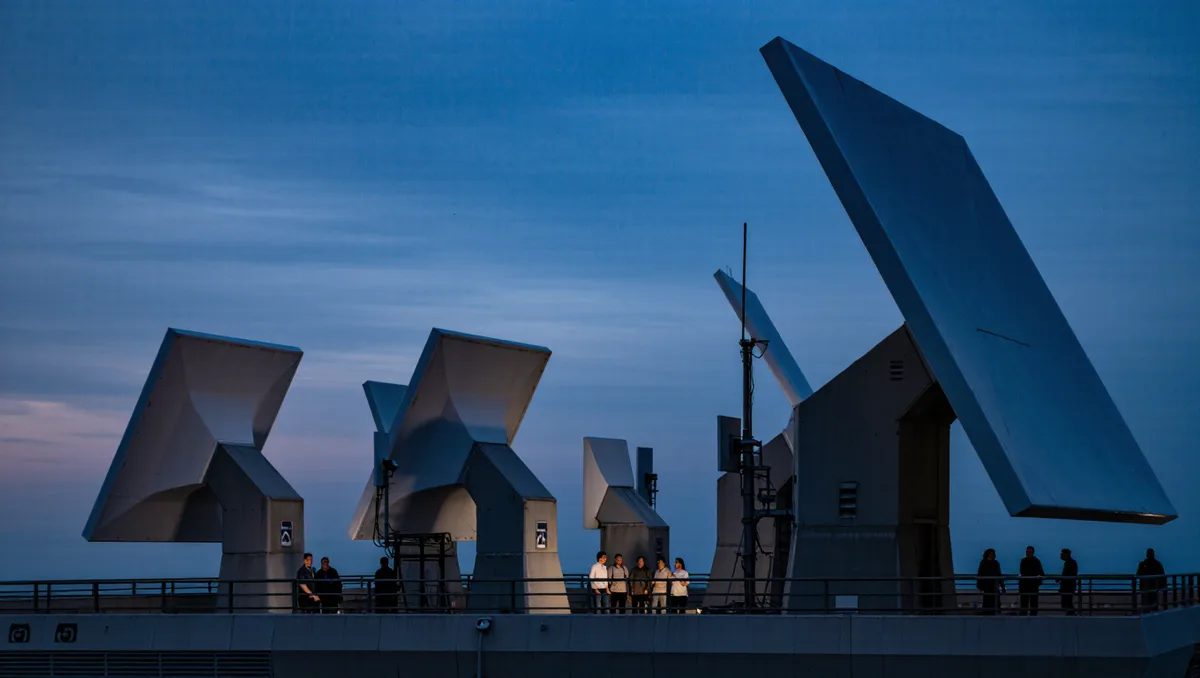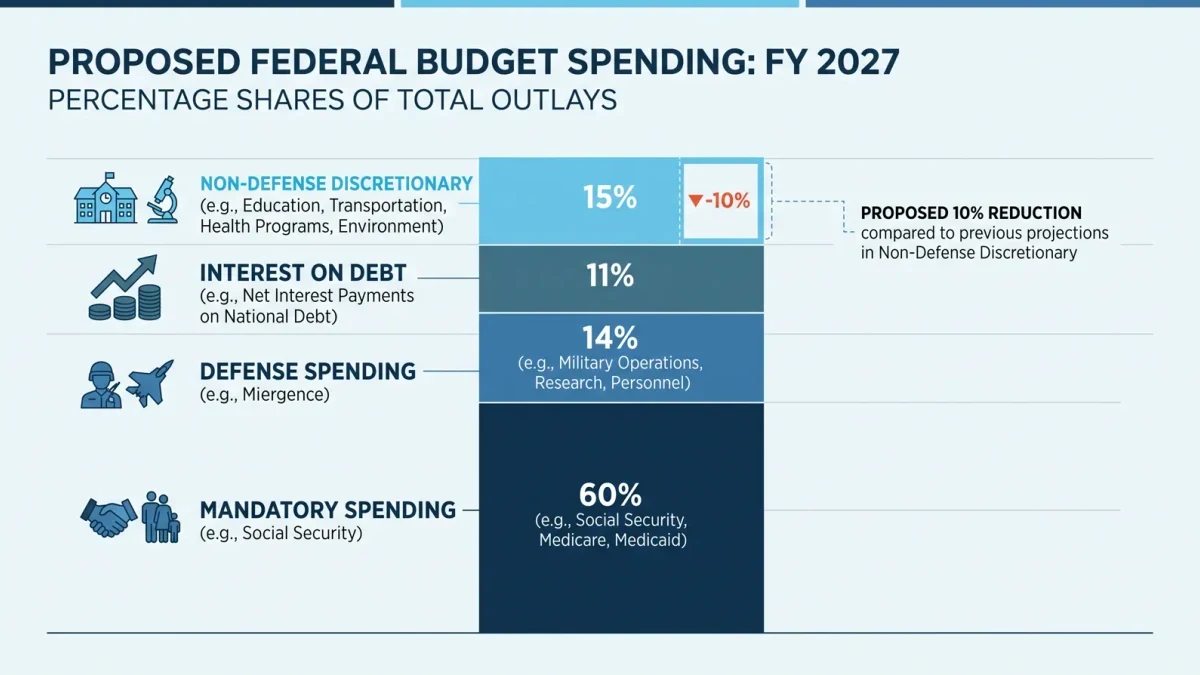
The FY2027 budget request nearly doubles the missile defense and defeat account, lifting it from $43.3 billion in fiscal 2026 to $85.8 billion per request materials and the Arms Control Association's briefing book. The jump makes homeland missile defense the fastest-growing category in the $1.5 trillion defense request and puts the Golden Dome initiative — announced by executive order on January 27, 2025 — on a funding trajectory that per BBC estimates could approach $1.2 trillion over two decades.
From executive order to budget line
Golden Dome began as the Iron Dome for America directive, signed by executive order on January 27, 2025, tasking the Department of War with building a layered homeland defense against ballistic, cruise, hypersonic, and potentially space-launched threats. For its first year the initiative existed largely as concept studies and contractor proposals. The FY2027 request changes that: a $42.5 billion single-year increase in the functional account converts architecture studies into procurement, research, and construction lines. Per the request materials, the growth concentrates in space-based sensing layers, next-generation interceptors, and command-and-control integration — the elements officials describe as the architecture's backbone.
What the administration says it will build
Per Defense Secretary Pete Hegseth, the system will be «fielded in phases, prioritizing defense where the threat is greatest» — language that acknowledges Golden Dome is not a single deployment but an evolving family of capabilities. The Congressional Research Service's Defense Primer IF13115 outlines the conceptual layers: boost-phase and midcourse intercept, terminal defense, space tracking, and a proliferated sensor constellation. The primer also catalogs the open technical questions — cost per intercept, the feasibility of space-based boost-phase defense, and the discriminator software that must sort warheads from decoys — that the doubled funding must now answer in hardware rather than slideware.
The cost trajectory
The BBC's estimate of roughly $1.2 trillion over two decades stands in sharp contrast to the annual account levels, implying that the FY2027 doubling is an early installment on a much larger commitment. Per CRS analyses of prior homeland defense efforts, layered architectures carry compounding costs: each intercept layer requires its own sensors, magazines, and logistics tail, and space components add launch and replenishment cycles that recur for the life of the system. Skeptics in Congress have already questioned whether the account's growth is sustainable alongside the rest of the FY2027 topline, while supporters argue the threat case — hypersonic weapons and secondary nuclear powers — justifies the trajectory.
What Congress will do with it
The authorization committees begin writing the FY2027 NDAA in June, and Golden Dome will be the budget's most conspicuous test case. Members must decide whether to authorize the full $85.8 billion, restructure it, or impose milestones — per CRS hearing practice, the standard tool for programs whose cost estimates carry wide uncertainty. The reconciliation-funded portion of the topline complicates oversight further, since mandatory-channel funding arrives with less annual leverage for committees to adjust. Watch for milestone reporting requirements, independent cost assessment language, and any attempt to split the account into discrete program elements with individual justification.
Why it matters
The doubling of missile defense and defeat funding is the clearest statement yet of administration priorities within the FY2027 request: no other functional account approaches a 98 percent single-year increase. Whether the architecture matures into a fielded capability or stalls on physics and cost curves, the FY2027 request establishes that homeland missile defense now occupies the center of American defense investment — with a decades-long financial tail that Congress is only beginning to examine.