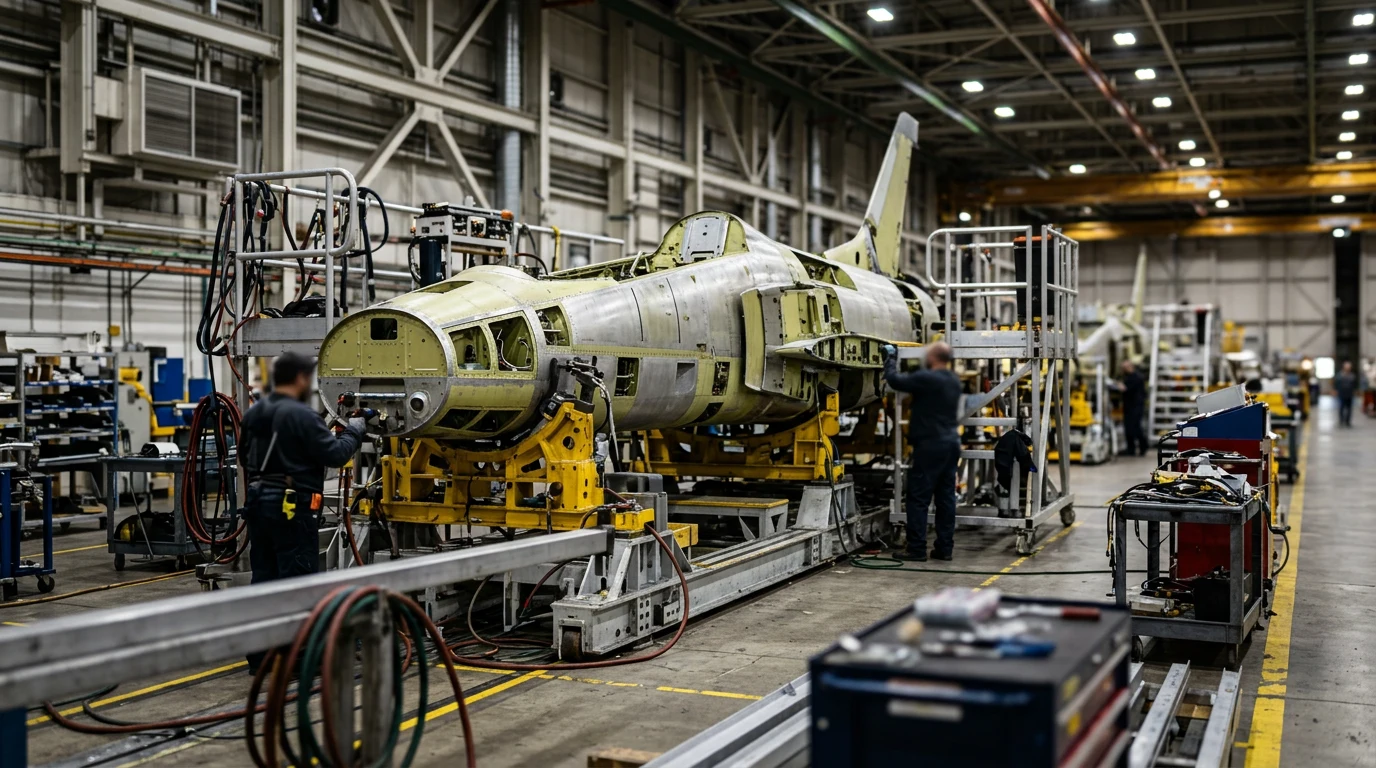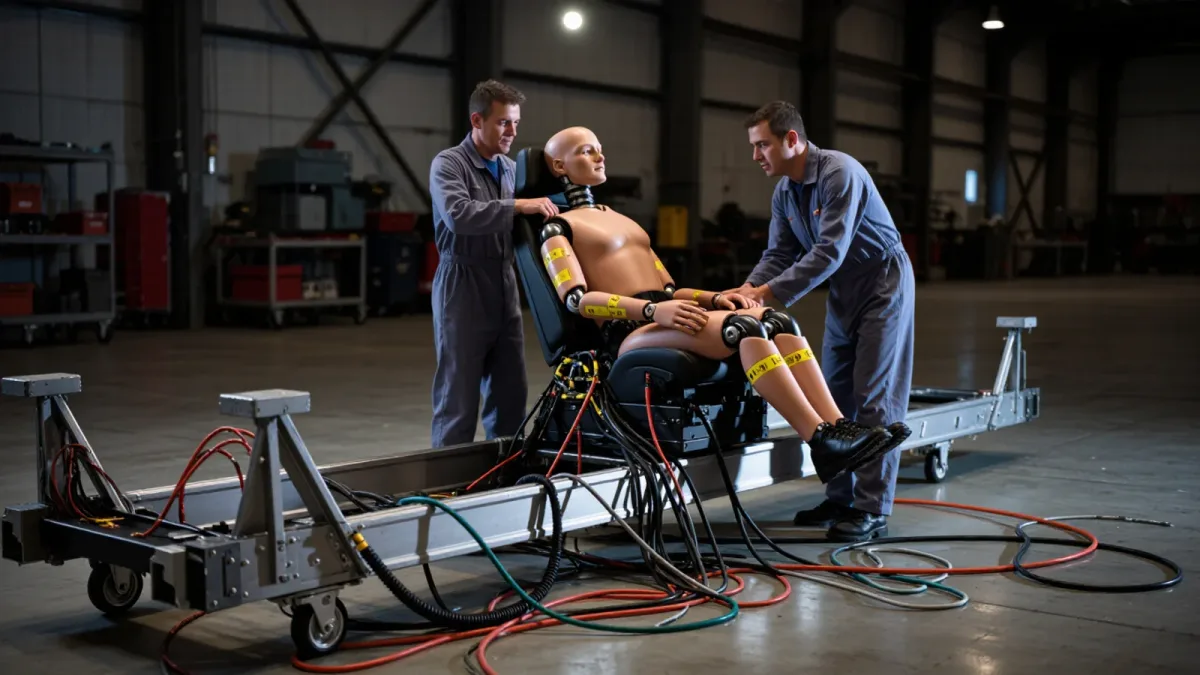
Ejection seats earn certification the hard way: through hundreds of sled, tower and wind-tunnel tests in which instrumented mannequins ride the seat through its full escape envelope. Martin-Baker, the industry's largest seat maker, says its seats have saved more than 7,500 aircrew lives to date. Every US fighter program inherits that test regime before a single pilot straps in.
What must an ejection seat prove before certification?
A seat must demonstrate safe escape across the aircraft's entire airspeed and altitude envelope, from a zero-speed, zero-altitude bailout on the runway to a high-speed, high-altitude departure. Certification authorities judge the seat against a defined set of injury criteria, including spine compression loads and limb flail limits.
For US Air Force aircraft, the seat's performance is folded into the aircraft specification, and test data must show the escape system meets those injury thresholds at every point in the envelope. The F-35 program illustrates the standard: its seat had to be qualified for crew members across a wide range of body sizes before the fleet was cleared for all pilots, an issue that surfaced publicly in 2019 when test data led the Air Force to temporarily restrict lighter aircrew while fixes were evaluated, per Air Force statements at the time.
How do crash-test dummies stand in for pilots?
Test programs use anthropomorphic test devices, the same instrumented mannequin family borrowed from automotive crash testing, sized to represent small, mid and large aircrew. Accelerometers in the head, chest and pelvis record the loads the ejection sequence delivers to a human body.
- Small-stature dummies verify the seat still positions and restrains a pilot close to the minimum aircrew height standard.
- Large dummies check that seat acceleration, harness loads and parachute opening forces stay within injury limits at the top of the range.
- Instrumentation converts every run into spine-load and acceleration traces that engineers compare against published human-tolerance criteria.
The F-35's troubles with lightweight aircrew showed why the dummy matrix matters. Early seat qualification data left a gap in protection for pilots below a certain weight, and the services paused low-speed ejection qualifications until Collins Aerospace, the seat's developer, and Martin-Baker worked corrective measures, per company and service statements in 2019.
Why do rail and sled speeds matter so much?
Ground test tracks let engineers fire a live seat at exact, repeatable speeds and accelerations that no flight test could safely reproduce. The seat is mounted on a rail sled, propelled to a target velocity and fired through instrumented gates that measure trajectory, stability and loads.
Envelope points at several hundred knots equivalent airspeed are typically demonstrated this way, because the wind blast at those speeds is what drives helmet, oxygen-mask and limb-retention design. Sled testing also captures the catapult-to-rocket transition, the phase where the seat leaves the rails and the underseat rocket takes over, which is where the harshest acceleration spikes occur.
From sled to sky
Once ground data clears injury criteria, the program moves to tower and airborne tests. Ejection test aircraft, typically modified two-seat jets with the rear seat instrumented, carry dummies through live airborne ejections at defined altitude and speed combinations. Only after those runs match the sled predictions does the seat move toward fleet clearance.
What role does canopy jettison play?
A seat cannot save a pilot if the canopy is still in the way, so jettison testing runs in parallel with seat testing. Each aircraft has a demonstrated sequence: frangible canopy panels, explosive charges or rocket-assisted canopy removal that clears the escape path faster than the seat can reach it.
Programs validate jettison across the speed envelope as well, because airflow loads a canopy differently at 250 knots than at taxi speed. Fail-safe logic matters too: if the jettison system fails, seats such as the Martin-Baker designs used in many Western fighters retain a canopy-breaker capability, and test programs demonstrate that backup path with dummies as well.
Who builds and certifies the seats?
Two names dominate Western military aviation. Martin-Baker, the British manufacturer, has supplied escape systems since the 1940s and says its seats have saved more than 7,500 lives. Collins Aerospace builds the ACES II seat that equips most US Air Force fighters and bombers, including the F-16, F-15, F-22 and B-2, per Air Force fact sheets, and developed the ACES 5 as its successor for the B-21 and upgrade paths.
Certification itself is a government act, not a company one. The program office, the airworthiness authority and the test wing review the full qualification dataset before the seat and aircraft combination is declared safe for operational aircrew. Contractor data supports the decision, but the services own the risk signature.
The US-F-35 exception
The F-35's US16E seat, produced by Martin-Baker with Collins as a major supplier, is a single seat qualified for all US service variants. Its development overlapped with a broader Air Force study of seat performance across body sizes, and the resulting data reshaped how later programs weight dummy variants in their test matrices, per Air Force testimony to Congress in 2019.
How do real ejections feed back into design?
Every fleet ejection is investigated, and the results loop back into certification assumptions. The services maintain centrally reported databases of seat performance, injury outcomes and failure modes, and manufacturers use the cases to refine seats, harnesses and survival kit integration.
That feedback is one reason seat design has converged: predicted trajectories, spinal injury criteria and restraint geometry have all been sharpened by decades of operational escapes. A seat cleared today carries the accumulated evidence of every one that came before it.
What happens after a seat is fielded?
Certification does not end at initial fielding. Time-expired cartridges, rocket motors and drogue devices are pulled and refurbished on scheduled cycles, and seats are periodically re-tested when the aircraft envelope grows or new crew equipment, such as heavier helmets and night-vision gear, changes the load case.
New aircrew equipment has repeatedly forced re-qualification work. Heavier helmets alter head-neck dynamics during the catapult stroke, and integrated life-support changes can shift the center of gravity the seat must accommodate. Programs budget for these re-tests because escape systems are certified as a pilot-plus-seat-plus-aircraft system, never as a seat alone.
Why certification rigor pays for itself
An ejection is a one-shot event with zero margin for design error, which is why the qualification process is among the most demanding in military aviation. The combination of sled physics, dummy instrumentation and live test data has pushed escape-system survivability to the point where most US Air Force ejections result in a saved life, a figure the Air Force Safety Center tracks through its annual aviation statistics.
For program managers, the lesson is straightforward: seat certification is long-lead work. Envelope expansions, aircrew-equipment changes and seat upgrades all reopen the test matrix, and no fighter ships without that matrix complete.
What does a seat test campaign look like week to week?
A qualification campaign is a rolling sequence of rig checks, sled runs and data reduction, with each envelope point signed off before the next higher speed is attempted. Engineers begin by statically firing the catapult and rocket motors on a ground rig, verifying thrust, burn time and trajectory predictions before any dummy is strapped in.
From there the matrix fans out. Low-speed runs check parachute deployment and ground clearance, high-speed runs check wind blast and limb restraint, and intermediate points map the region where recovery time is shortest. Each run produces spine-load traces, head-path video and parachute timing that feed the injury-criteria review, and a failed run sends the design back to the rig rather than forward to flight test.
Configuration control polices the whole effort. A new cartridge lot or a modified harness stitch pattern triggers re-testing of affected points, so programs freeze seat hardware early. In escape systems, small changes are never small.