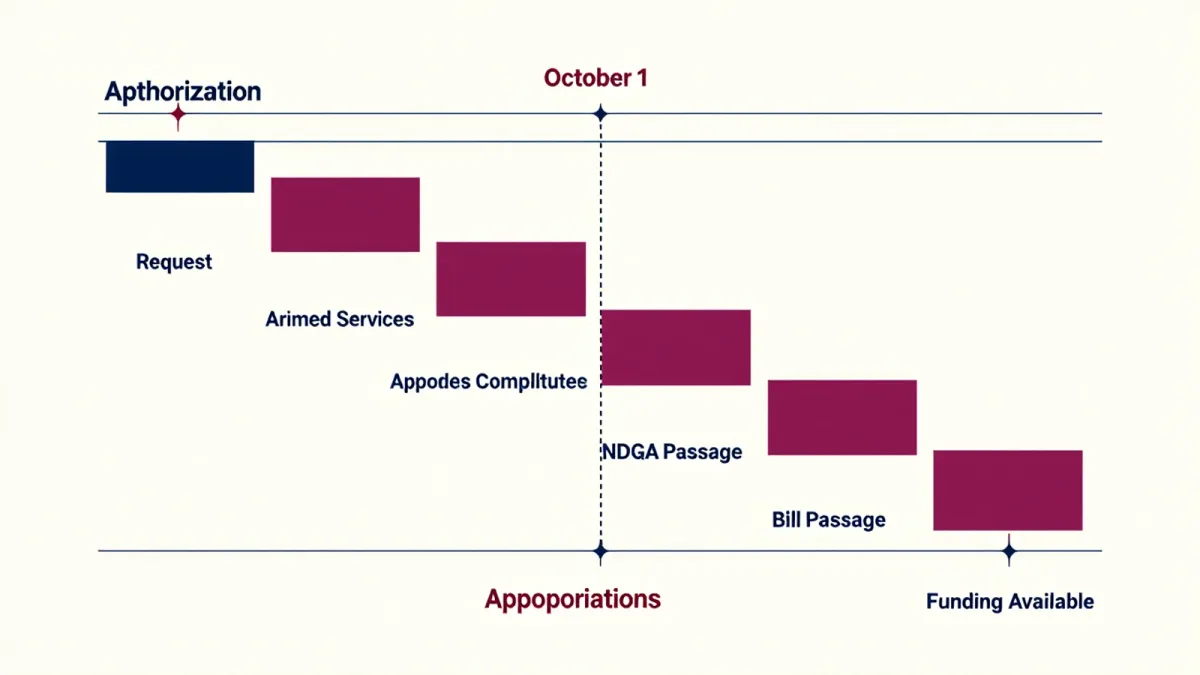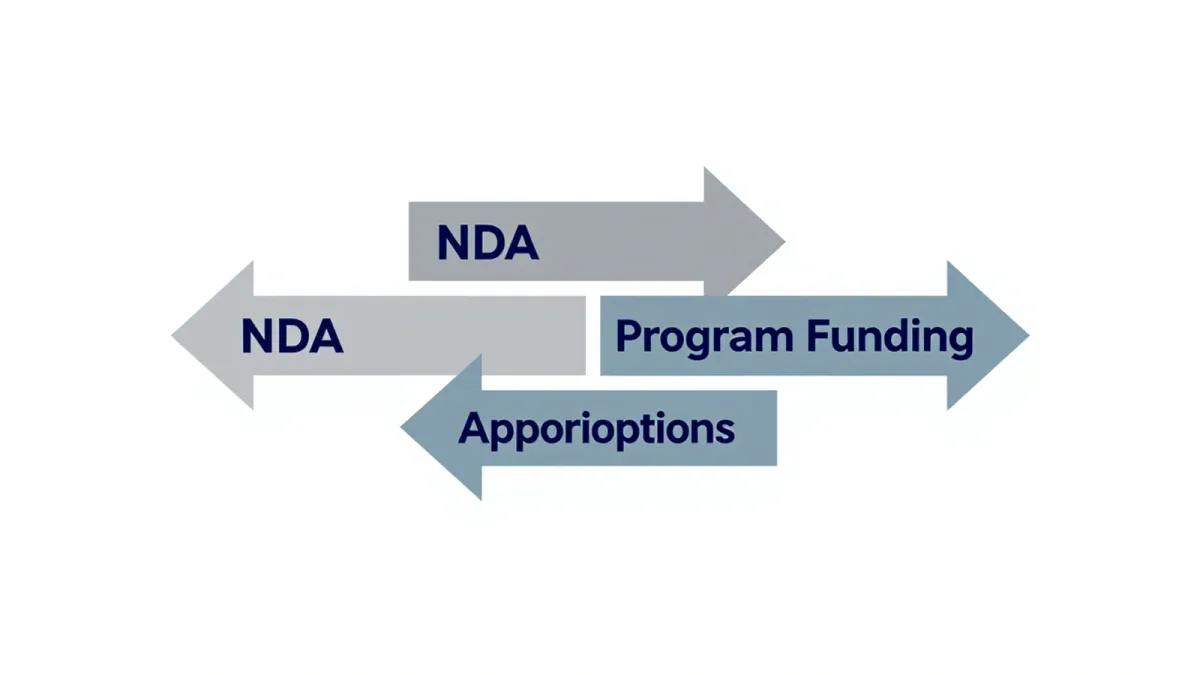
The NDAA authorizes defense programs, end strengths, and policy; the appropriations bill provides the actual money, and a program cannot legally spend until both are law. Each year the defense authorization act covers the policy side — aircraft quantities, acquisition reforms, personnel authorities — while the defense appropriations act sets dollar ceilings across hundreds of accounts. Per the House Armed Services Committee's own description of the process, authorization without appropriation leaves a program approved on paper but unfunded, with an as-of-2026 pattern of Congress passing both bills months apart.
Advanced Primitive publishes information, not legal advice.
Why does Congress split defense law into two bills?
The split dates to the Legislative Reorganization Act of 1970 and the two-committee structure it produced. The House and Senate Armed Services Committees write the NDAA and jurisdiction over defense policy sits with them permanently. The Appropriations Committees' defense subcommittees write the spending bill, and the Budget Act of 1974 hardened the division: an authorization creates or continues a program, an appropriation releases the funds. Conferees on each bill work separately, so quantities in the NDAA and dollar lines in the appropriations act are negotiated by different groups of lawmakers.
What exactly does the NDAA decide?
The NDAA sets authorized-to-be-appropriated ceilings, authorizes weapons quantities, sets end-strength numbers for each service, and writes acquisition policy. The FY2024 NDAA, signed in December 2023, authorized $886 billion to the Department of Defense per committee summaries — a ceiling, not a check. It also carries the reforms: the 2022 NDAA created the commission on planning, programming, budgeting and execution reform, whose 2024 report fed later acquisition rewrites. The bill is considered must-pass, which per Congressional Research Service histories has kept a defense authorization act enshrined into law every year for more than six decades.
What does the appropriations bill add that the NDAA cannot?
Money, and the legal authority to obligate it. An appropriation provides budget authority; without it, the Pentagon operates under a continuing resolution that freezes spending at prior-year levels and, per DoD testimony in multiple years, bars new starts and production rate increases. The two bills also diverge in structure: the appropriations act funds specific accounts — aircraft procurement, missile procurement, research, development, test and evaluation — by line, while the NDAA authorizes programs by title. A service can therefore see a program authorized in the NDAA at one quantity and funded in appropriations at a smaller one, as happened repeatedly with F-35 procurement lines in the late 2010s when appropriators bought fewer jets than authorizers endorsed.
What happens when one passes and the other does not?
The authorization can become law and the government still runs out of money at fiscal year start. That combination has become routine: in fiscal 2024, the NDAA was signed in December 2023 while full-year appropriations arrived only in March 2024, per the CRS timeline — nearly half the year under continuing resolutions. During the gap, programs cannot enter full-rate production or sign new-start contracts, and per service testimony the delay itself carries cost: officials have repeatedly told Congress that each month of CR adds schedule and dollars to acquisition programs, though the services have not published a single consolidated figure.
How do the two bills get reconciled when they disagree?
Separately, through conference committees that cannot merge. NDAA conferees reconcile House and Senate versions of the policy bill; appropriations conferees reconcile the spending bill. If the House authorizes 25 additional aircraft and the appropriators fund 15, nothing in the process forces the numbers together — the Pentagon simply cannot obligate beyond the appropriated amount. GAO's budget-process primers describe this as the ordinary condition of defense budgeting, not an anomaly, and in most years the final funded quantity sits between the two bills' positions.
How is the topline for each bill set?
Both bills operate inside the same budget resolution topline, but they divide it differently. The services build their requests through the planning, programming, budgeting and execution process — PPBE — which per the commission that studied it in 2024 still largely follows a two-year programming rhythm designed for the 1960s. The President's budget request arrives in February or March; armed services committees mark up the authorization in June; appropriations subcommittees mark up spending in the same weeks. The defense topline itself is negotiated between the White House and congressional leadership, and in years governed by statutory budget caps the two bills must squeeze their competing priorities into the same ceiling. When the caps bind, authorizers protect quantities while appropriators protect readiness accounts, and the friction shows up as a funded quantity lower than the authorized one.
What are the classic friction points between the two bills?
Three recur almost every year. First, quantities: the NDAA authorizes aircraft and ship counts that appropriations does not fully fund, as with F-35 lots in the late 2010s, when appropriators consistently bought fewer Joint Strike Fighters than the authorization endorsed. Second, new starts: continuing resolutions bar new programs, so a program created in the NDAA can wait months for its first dollar. Third, reforms: the NDAA can restructure an acquisition process, but the appropriations act decides whether the offices and pilot programs meant to implement it receive staffing money. GAO has documented cases where authorized reforms languished because no appropriation followed — the authority existed, the capability did not.
What should contractors watch in each document?
In the NDAA: quantities, multiyear procurement authorizations, and policy riders that change what can be bought — export authorities, industrial-base mandates, restrictions on divesting or retiring aircraft. In the appropriations act: the account lines and any bill language, because appropriators write binding directions in the explanatory statement that tell the services exactly how fast to obligate each account. Contractors also watch the difference between funded and unfunded priorities lists; a program appearing on a service's unfunded list has advocates in Congress but no executive-branch sponsorship, and per historical patterns only a fraction of unfunded items end up in either bill. The two calendars matter as much as the content: award timing for new-start contracts has slipped with the appropriations calendar in most recent fiscal years, per CRS counts of late enactments since 2011.
Does the split ever get fixed?
Proposals surface regularly and stall on jurisdiction. Some lawmakers have proposed merging the armed services and defense appropriations subcommittees; others have proposed biennial budgeting or automatic continuing-resolution penalties on the Pentagon. The PPBE reform commission's 2024 report recommended resequencing the budget calendar so authorization could precede the President's request, but none of the structural proposals has cleared Congress, and per the CRS record the two-bill architecture has now operated unchanged in essentials for five decades. For planning purposes, treat the split as permanent: two bills, two committees, two calendars — and a program only becomes real when both have acted.
- Authorization — statutory permission for a program, quantity, or activity; creates the legal basis but no money.
- Appropriation — budget authority that permits obligation and outlay; the enforceable limit.
- Continuing resolution — temporary funding at prior-year rates when appropriations are late; generally bars new starts.
The practical read for industry: track both bills, because the NDAA tells you what the program will be and the appropriations act tells you when it starts. Contractors plan award timing against the appropriations calendar, and per historical CRS counts, late full-year appropriations have been the norm rather than the exception since fiscal 2011. The NDAA is the blueprint; appropriations is the bank transfer. Only one of them moves hardware.