The United States has not run a Base Realignment and Closure round since 2005, even though successive Defense Secretaries have asked for one and per DoD infrastructure analyses submitted to Congress, projected excess capacity sits in the single digits of percentage points — far below the statutory case the law demands for a new round. The five completed BRAC rounds, in 1988, 1991, 1993, 1995 and 2005, closed or realigned hundreds of installations, but the process that made them possible has been politically unusable for nearly two decades.
Understanding why requires looking at how BRAC was designed, what the last round cost, and what current law actually requires before another round can start.
How did the BRAC process work?
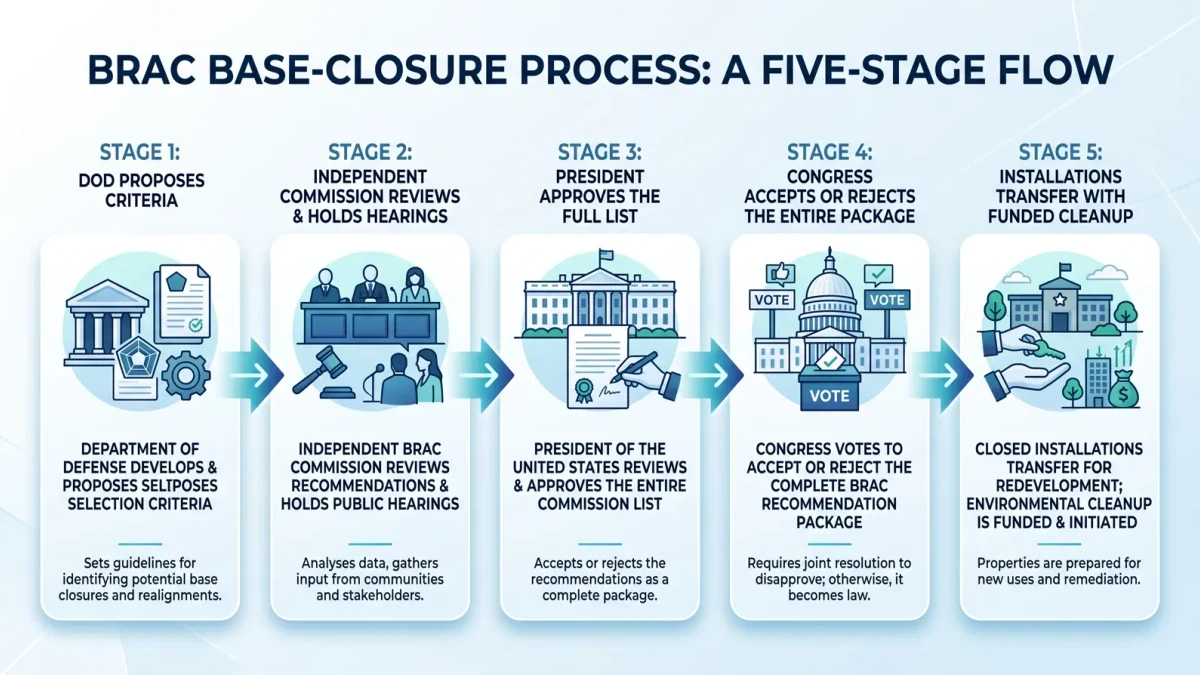
BRAC was built to take politics out of base closure, which had paralyzed the process in the 1970s when every closure decision died in Congress. The 1988 and 1990 laws created an independent commission that reviewed a Pentagon-proposed list, held hearings, amended it, and sent a final list to the President and Congress for an up-or-down vote with no amendments permitted. If neither the President nor Congress acted, the list became law. That structure let members of Congress vote once on the whole package rather than fight installation by installation.
The design worked as intended through four rounds. Per DoD BRAC program records, the 1988 through 1995 rounds closed 97 major installations and realigned hundreds of others, producing estimated recurring savings that GAO later audited at lower levels than predicted but still in the billions of dollars annually once environmental cleanup and property disposal progressed.
What happened in the 2005 round?
The 2005 round broke the cost model. DoD initially estimated implementation costs near $15 billion against roughly $4 billion in recurring annual savings; per GAO follow-on reviews, implementation costs grew toward $35 billion, and GAO reported that net savings would not materialize until years after the round ended, with break-even projected around 2018. The round also shifted its logic: instead of closing excess bases, most recommendations realigned missions, moving thousands of personnel stateside from overseas and consolidating functions.
- Five rounds total: 1988, 1991, 1993, 1995, 2005
- 2005 round: costs roughly doubled from initial DoD estimates, per GAO
- Net savings delayed by about a decade versus the original projection
- Environmental cleanup and reuse made closure slower than predicted
Communities that lost installations spent years on reuse planning, and per GAO property-transfer reviews, some sites took longer than a decade to reach productive reuse. The 2005 experience gave both parties a shared cautionary tale: the round promised savings and delivered a long, expensive implementation with savings deferred past most political memory.
What did the earlier rounds actually save?
The 1988-1995 record is the strongest argument BRAC's defenders have. Per GAO assessments of the completed rounds, recurring net savings from the first four rounds were estimated in the low billions of dollars annually once one-time costs were absorbed, and the closures concentrated missions on installations with the best infrastructure and training access. Force drawdowns after the Cold War made the case urgent: the active force shrank by roughly a third in the early 1990s while the base structure initially stayed largely intact, which is how DoD built its mid-1990s estimates of 20 percent or more excess capacity.
The 2005 round's problems, per GAO testimony and reports afterward, came less from the commission model than from execution: aggressive realignment logic, optimistic military construction estimates, and cost growth in environmental and information-technology migration. Those lessons, not the vote structure, are what later authorizers cited when they tightened conditions on any future round.
What does the law require for a new round?
Under the BRAC statute at 10 U.S.C. 2687 and successor provisions, the Defense Secretary must submit a budget request and certification tied to identified excess capacity, and the authorization acts since 2006 have added procedural bars: per Congressionally enacted conditions still in force, a new round requires DoD to complete an infrastructure capacity analysis, publish the methodology, and in some statutory formulations demonstrate that projected excess capacity exceeds 20 percent of the department's infrastructure. DoD's analyses submitted in the late 2010s reported far lower numbers, which forecloses the statutory path even before the political argument begins.
Secretary Mattis called for a BRAC round in 2017 and 2018, and Congress declined both times, with authorizers citing the 2005 cost experience and DoD's own capacity data. No administration since has forwarded a round, and per Congressional Research Service summaries of base closure legislation, stand-alone BRAC authorization bills have been introduced repeatedly without advancing.
How much excess infrastructure does DoD actually carry?
The honest answer is that the estimates have converged downward. DoD's infrastructure capacity analyses of the late 2010s, submitted to Congress, projected excess capacity in the mid-single digits for most components, a sharp drop from the roughly 20 to 25 percent excess that DoD estimated in 2004 before the 2005 round. Per GAO reviews, part of the reduction is real consolidation from BRAC history, and part reflects changed methodology: force structure, mission growth in cyber and space, and distributed training demands consume infrastructure that base-closure math once called excess.
Critics answer with cost-per-plant-replacement-value arguments: DoD manages hundreds of thousands of buildings, a large share built during World War II and the Cold War, and per annual DoD facilities reporting, deferred maintenance backlogs have run in the tens of billions of dollars. Those figures fuel periodic congressional interest in consolidation without a full BRAC, using tools like authority to lease, exchange or dispose of individual facilities outside the round structure.
Installation geography is also a personnel issue. Per DoD basing studies of the 2010s, family housing, school access and spouse employment weigh on retention, and closed rounds deliberately moved units toward bases with strong community infrastructure. Any future round must argue against a force that remembers past disruptions, and commanders weigh community relationships in their operational assessments, a soft factor the commission model has never fully priced.
Could base closure happen without BRAC?
Partially, and it does. Congress has granted authorities for disposal of individual properties, public-private partnerships on underused land, and demolition of derelict facilities, all of which move inside annual budget requests without the up-or-down commission vote. Per DoD installations reporting, the department pursues these case-by-case actions continuously. What they cannot do is the system-wide optimization BRAC promised, because closing a base requires statutory authority and the communities, and their senators, hold the veto points.
Why does a frozen BRAC matter for defense policy?
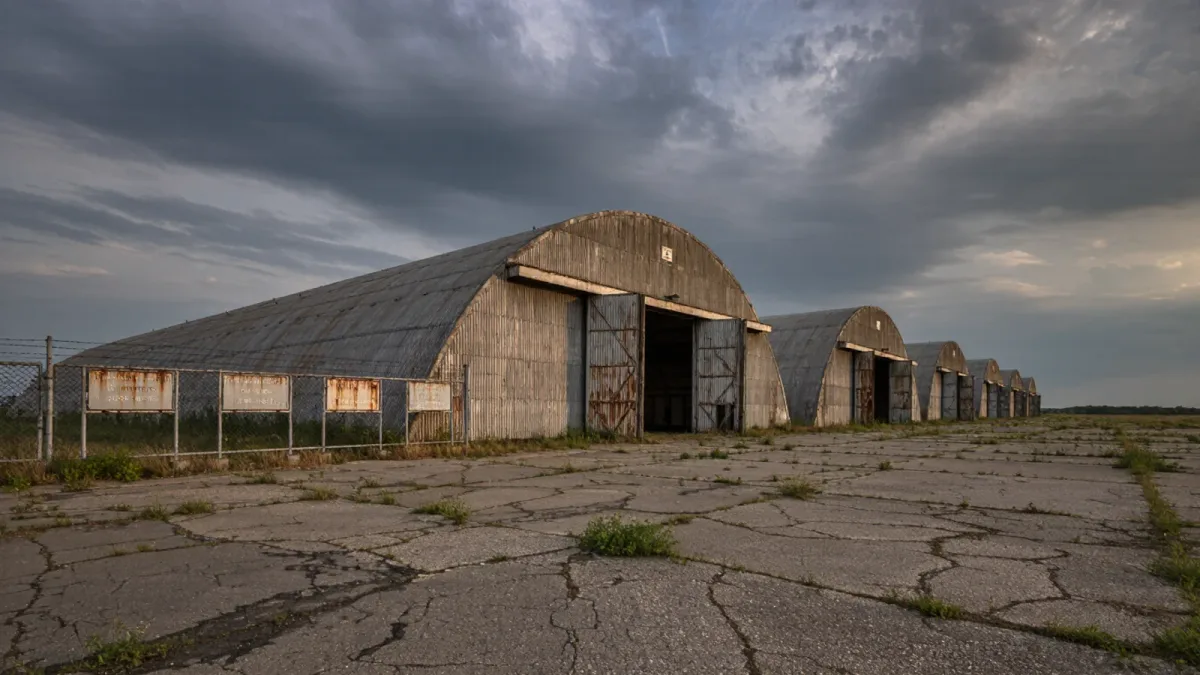
Every dollar spent heating an empty hangar or guarding a fence line at an underused installation is a dollar unavailable for force modernization, and per DoD facilities sustainability reporting, the deferred maintenance backlog competes directly with readiness budgets. The 2025 reconciliation-era budget debates and the modern great-power posture debate have renewed the question: if the force is shifting to Indo-Pacific dispersion and contested logistics, the Cold War base map is a planning document from another era. But the BRAC freeze holds as long as three things stay true — the statutory 20 percent test goes unmet, the 2005 cost memory stays fresh, and no administration wants to spend its political capital closing bases in the districts of the legislators it needs for the rest of its program.