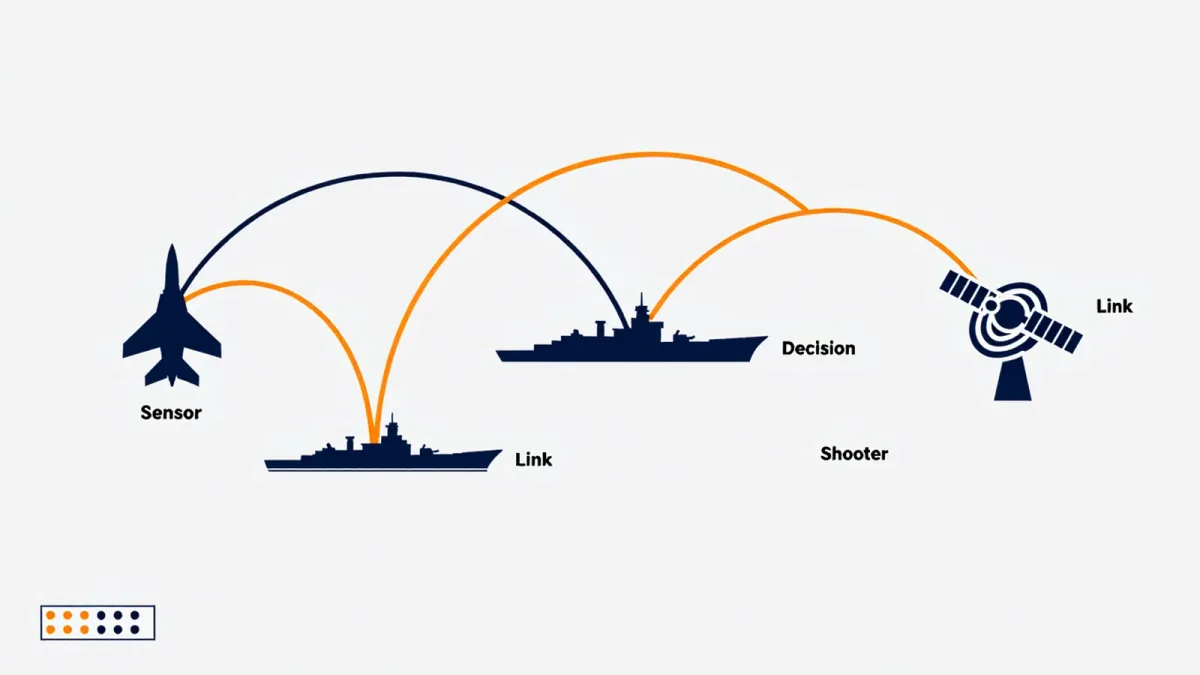
Base counter-drone defense works as a stack of four layers: detect, decide, disrupt, destroy. Detection radar such as the Ku-band Radio Frequency System watches the sky for small airframes; electronic warfare jammers cut a drone's command link; and kinetic interceptors or directed energy kill what keeps flying. The Marine Corps' L-MADIS demonstrated the integrated approach in July 2019, downing an Iranian-made drone over the Strait of Hormuz, per US military announcements, and the Air Force Research Laboratory's THOR microwave system has defeated drone swarms in service testing since 2021.
No single layer closes the gap. The design problem is matching the cheapest effective layer to each threat, because a $10,000 quadcopter does not justify a million-dollar interceptor.
What does the detection layer consist of?
Detection blends complementary sensors because small drones defeat any one of them. Radar tuned for small, slow, low targets is the backbone: the Ku-band Radio Frequency System, developed through MIT Lincoln Laboratory and fielded by the Army since 2019, was built originally for counter-rocket, artillery and mortar duty and proved effective against drones as well. Radio frequency detectors listen for the uplink and downlink of piloted drones, which works until the drone flies autonomously. Electro-optical and infrared cameras confirm identification, and acoustic sensors add close-range coverage.
The integration problem is the real cost. Each sensor brings false positives, from birds to ground clutter, and the counter-UAS command system has to fuse them into one recognized air picture with rules of engagement attached. Field reporting from Middle East deployments since 2021, where Iranian-backed drone attacks hit US positions repeatedly, drove investment in exactly this fusion layer.
How does the electronic warfare layer work?
Most commercial and tactical drones depend on a radio link, so jamming that link is the cheapest defeat available. The disruption layer covers RF jamming of command and navigation signals, GNSS spoofing that walks a drone off course, and protocol-level takeover of some commercial systems. The Marine Corps' Light Marine Air Defense Integrated System pairs a radar-equipped vehicle with an electronic warfare vehicle to detect, track and defeat drones as one system, and it earned its validation in the July 2019 Hormuz engagement.
Jamming has structural limits. Fiber-optic-guided drones, a category that spread in Ukraine from 2024 onward per open-source reporting, carry no RF link to jam. Autonomous drones that fly pre-planned attack profiles also shrug off link jamming. Every advance in drone autonomy erodes the cheap layer, which is why the kinetic and directed-energy layers keep growing.
What handles the drones that keep coming?
Kinetic interceptors and guns close the layer for drones that ignore jamming. The Army's Coyote Block 2 interceptor, built by Raytheon, has been the designated counter-swarm effector, and US forces used interceptor systems against Houthi one-way attack drones in Red Sea operations through 2024. Cheaper per shot, the laser-guided APKWS rocket has been employed against drones from Marine and Army systems, and the Army's directed-energy Stryker, the 50-kilowatt DE M-SHORAD Guardian, delivered beginning in 2022, adds a laser option with a cost per engagement measured in kilowatt-hours rather than missiles.
The economics discipline the whole design. A defense that spends scarce interceptors on $15,000 drones goes bankrupt winning. Layering exists precisely so commanders can escalate from jamming, the cheapest shot, upward only as the threat requires.
Where does THOR fit in the stack?
THOR, the Tactical High-power Operational Responder, is the Air Force Research Laboratory's high-power microwave system, built at Kirtland Air Force Base to counter drone swarms with a wide-area electromagnetic pulse rather than one kill per shot. AFRL reported successful swarm defeats in testing, and development of a follow-on system, Mjolnir, continued through 2023 and beyond. Its niche is the scenario jamming and guns handle badly: dozens of drones arriving together inside a defended perimeter's reaction time.
High-power microwave complements rather than replaces lasers. Lasers concentrate energy on a single target and need dwell time per kill; microwave systems flash a cone of sky and defeat many cheap airframes simultaneously. Both depend on the detection layer handing them a valid track, which loops back to the fusion problem.
What has real combat taught base defenders?
Three lessons from the Middle East and Ukraine stand out. Attacks now come mixed: one-way attack drones alongside rockets and missiles, forcing sensors to sort a raid by class in seconds. The defense must run continuously, for months, which exposes power, cooling and maintenance as design constraints, not afterthoughts. And attrition math matters: Houthi drone campaigns in 2023 and 2024 forced US forces to weigh multi-million-dollar interceptors against four-figure airframes, a trade the Government Accountability Office and service leaders discussed publicly.
Base defense planners now treat the counter-UAS stack as permanent infrastructure, with dedicated radar, a fusion command post, and layered effectors, rather than a deployed add-on.
How do bases actually buy these layers?
Procurement has followed the operational record. After repeated drone attacks on US positions in the Middle East from 2021 onward, the department pushed counter-UAS funding through emergency and rapid authorities, fielding commercial and service systems to deployed units before formal programs of record caught up. The Army's portfolio, spanning KuRFS radar, the Coyote interceptor and directed-energy prototypes, became the department's designated counter-UAS lead, consolidating requirements that previously sat scattered across services, per Army and Pentagon announcements.
For vendors, two features define this market. First, speed: rapid fielding authorities reward systems that arrive with safety data, spectrum approvals and operator training already packaged. Second, iteration in theater: systems deployed as prototypes collected the performance data that later contract decisions relied on. The layered base-defense architecture described here is therefore less a single program than a continuously re-ranked portfolio, with each layer's champion decided by what worked during the last deployment cycle.
Test infrastructure is the quiet third feature. The Army and Navy run persistent counter-drone test events, from White Sands firing ranges to shipboard trials, and results from those events feed directly into fielding decisions, per service releases. Vendors that plan their own instrumented testing, rather than waiting for government ranges, move faster through the queue. In a market where requirements update with every new drone design that appears in a theater, the loop from observation to test to fielding is the product.
Frequently Asked Questions
What is L-MADIS?
The Light Marine Air Defense Integrated System is a Marine Corps counter-drone system pairing radar-equipped and electronic warfare vehicles to detect, track and defeat small drones. It scored the first widely publicized US defeat of an Iranian-made drone, over the Strait of Hormuz in July 2019, per US military announcements, and has deployed with Marine air defense units since.
What is the THOR weapon system?
THOR, the Tactical High-power Operational Responder, is an Air Force Research Laboratory high-power microwave system designed to defeat drone swarms with a wide electromagnetic pulse. AFRL reported successful swarm defeats in testing, and its successor effort, Mjolnir, carried the technology toward operational transition from 2023 onward.
Why not just shoot down every drone with a gun or missile?
Cost and capacity. Effectors suitable for cruise missiles are poor matches for $15,000 quadcopters, magazine depth runs out in a sustained drone campaign, and every kinetic shot adds debris over the base. The layered approach escalates from jamming, the cheapest defeat, to interceptors and directed energy only when the threat requires it.
Can counter-drone systems stop fiber-optic-controlled drones?
Not with jamming. Fiber-optic-guided drones carry no radio link, so the electronic warfare layer is blind to them. Defeat requires the kinetic or directed-energy layers, which puts a premium on radar and electro-optical detection finding them early. The category's spread from Ukraine since 2024, per open-source reporting, is driving that sensor emphasis.