Joint All-Domain Command and Control, now Combined JADC2, is the Department of Defense's effort to connect any sensor to any shooter across services and allies, and in February 2024 the department announced a minimum viable capability combining software, data standards and exercises, per DoD announcements. The hard part is physical: the tactical data links that carry targeting and position data were built service by service and generation by generation. Link 16, the workhorse since the 1980s, does not natively carry the low-probability-of-intercept MADL waveform that F-35s use to talk to each other, and translating between them in real time, without giving away stealth aircraft positions, is the interoperability gap CJADC2 exists to close.
This primer walks through the links, the service networks and the programs attempting to converge them.
What is CJADC2, exactly?
JADC2 began as a department strategy signed in 2020, with an unclassified summary published in March 2022. The concept: instead of each service building its own kill chain, the department builds a shared fabric of sensors, networks, data standards and decision tools so a commander can pair the best available sensor with the best available shooter across domains. The C was added for combined operations with allies, acknowledging that most future fights are coalition fights. In February 2024, Deputy Defense Secretary Kathleen Hicks announced the achievement of a minimum viable capability, demonstrated through repeated exercises, with the department stating that AI-enabled tools had shortened decision timelines in test conditions.
CJADC2 is not a single program of record. It is an integration campaign across service networks, cloud infrastructure and data standards, with the Air Force's Advanced Battle Management System, the Army's Project Convergence and the Navy's Project Overmatch as the service contributions.
What does Link 16 do, and where does it fall short?
Link 16 is the NATO-standard tactical data link, carried by aircraft, ships and ground stations since the 1980s over the MIDS/JTIDS terminal family. It broadcasts position, track and engagement data across a common picture, and hundreds of thousands of terminals make it the closest thing allied forces have to a universal network. Its weaknesses are structural: line-of-sight propagation limits range without relays, and the waveform is detectable, which makes it unusable for stealth aircraft operating in contested airspace where emissions get you killed.
That second weakness drives the whole problem. A fourth-generation fighter and an F-35 over the same battlespace cannot share a targeting picture without an intermediary, because one speaks Link 16 in the clear and the other speaks a directional, low-probability-of-intercept waveform that was deliberately designed not to be compatible.
What is MADL, and why does it complicate the picture?
MADL, the Multifunction Advanced Data Link, is the F-35's stealth-optimized link: highly directional, low probability of intercept, designed to pass data among flight members without revealing the aircraft. It carries a fraction of Link 16's data types in a fraction of the spectrum, by design, and it was built for flight-level connectivity, not network-wide distribution. An F-35's targeting-quality data does not flow to a destroyer or a Patriot battery without a translation node.
Field solutions exist: the Navy's Cooperative Engagement Capability fuses sensor data across ships, and gateway systems can bridge MADL and Link 16, with industry and lab demonstrators, including the Air Force's GatewayONE effort announced in 2020, showing real-time translation in flight tests. But gateways are bolt-ons. CJADC2's premise is that translation should be a property of the network fabric, not an add-on pod on one testbed aircraft.
How do the service networks fit together?
Each service arrived with its own mature network. The Navy has CEC and Project Overmatch, aimed at connecting the fleet under contested communications. The Army has Project Convergence, its campaign of experiments, and the Integrated Battle Command System, which ties its air defense sensors and shooters. The Air Force has ABMS, built around resilient connectivity and data management. The 2021 Global Information Dominance Experiments and successor exercises through 2024 stitched pieces together at echelon, per DoD statements, and February 2024's minimum viable capability announcement claimed an all-service demonstration.
Two problems persist beyond the demos. First, spectrum and transport: every network competes for the same contested electromagnetic environment, and no amount of software creates bandwidth. Second, data standards: sensors produce formats that decision tools cannot fuse without a common schema, which is why the department emphasizes data-centric security and zero-trust architecture over terminal count.
What is the Space Force's Gatehouse role?
Space systems are CJADC2's transport layer, and the Space Force's Gatehouse effort, run through Space Systems Command, addresses the space side of the convergence problem: delivering resilient data transport and positioning, navigation and timing data that the joint network can trust, per Space Force announcements. The service frames it as part of a broader shift toward proliferated, resilient space architectures, since a command-and-control fabric is only as available as the satellites carrying it.
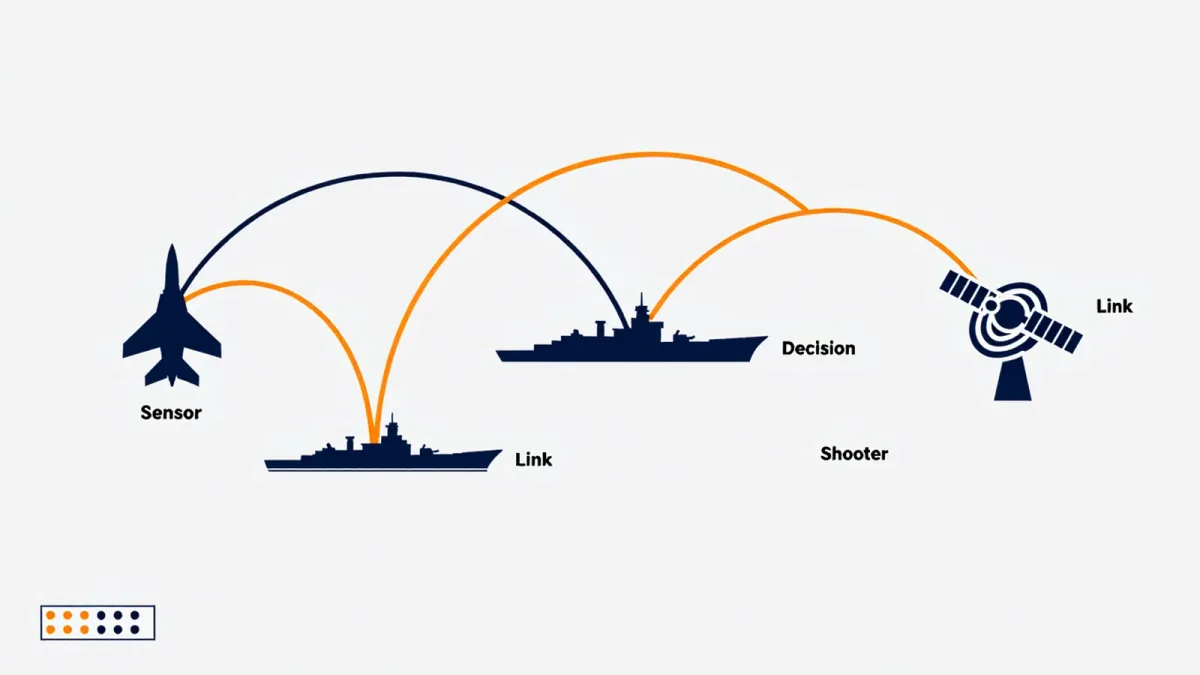
The converged vision, as service officials present it, runs sensor to space transport to decision tool to shooter, with encryption, data tagging and zero-trust principles applied at every hop. The Space Force contribution is making the space segment a designed component of that chain rather than a set of legacy constellations each service rents separately.
What should buyers watch next?
Three indicators tell whether CJADC2 is becoming real procurement rather than exercise vocabulary. Contract structure: whether the department funds open-standards data fabrics and multi-service gateways as programs of record, with real money in budget lines through the mid-2020s. Standards adoption: whether industry data schemas and MOSA interfaces are enforced in awards, which determines if new sensors plug in or repeat the Link 16 problem. And coalition interoperability: whether allied data links, the whole point of the combined C, are admitted to the fabric at classification levels allies can operate in. Watch those, not the demos.
Frequently Asked Questions
What is the difference between JADC2 and CJADC2?
JADC2 is the original Joint All-Domain Command and Control concept, framed in a 2020 strategy with a public summary in March 2022. The C for Combined was added as the department made coalition operations central, and officials used CJADC2 for the effort that announced its minimum viable capability in February 2024. The concepts are continuous: same architecture, wider membership and a stated focus on data standards and decision speed.
Can Link 16 and MADL talk to each other?
Not natively. Link 16 is a broadcast-capable NATO standard waveform with wide connectivity but detectable emissions; MADL is the F-35's directional, low-probability-of-intercept link built for stealth flight-level use. Bridging requires a gateway node that translates in real time while protecting the F-35's emissions discipline, demonstrated by efforts such as the Air Force's GatewayONE in 2020, per service statements.
What did the February 2024 CJADC2 announcement actually deliver?
A minimum viable capability: an integrated set of software, data standards and connectivity demonstrated across all service components in exercises, announced by Deputy Defense Secretary Kathleen Hicks in February 2024, per DoD statements. The department characterized it as an iterative foundation, not a fielded system, with follow-on increments adding sensors, allied participants and AI-enabled decision tools.
What is the biggest obstacle to CJADC2?
Interoperability under contested conditions. The legacy links and service networks were never designed for one another, the electromagnetic spectrum is a finite contested resource, and data standards lag the sensors producing them. Classification barriers between the United States and allies add a combined dimension. Exercises have demonstrated pieces; the durable fix is standards-based architecture funded as programs of record.