MOSA, the modular open systems approach, is the legally mandated design philosophy behind modern military avionics: systems are built from well-defined, standards-based interfaces so hardware and software from different vendors can be swapped without redesigning the aircraft. Congress wrote the requirement into Title 10 acquisition law, and programs that ignore it now answer to oversight bodies for doing so. Open Mission Systems, HOST/T and a family of related standards are how aviation implements it.
What exactly is MOSA?
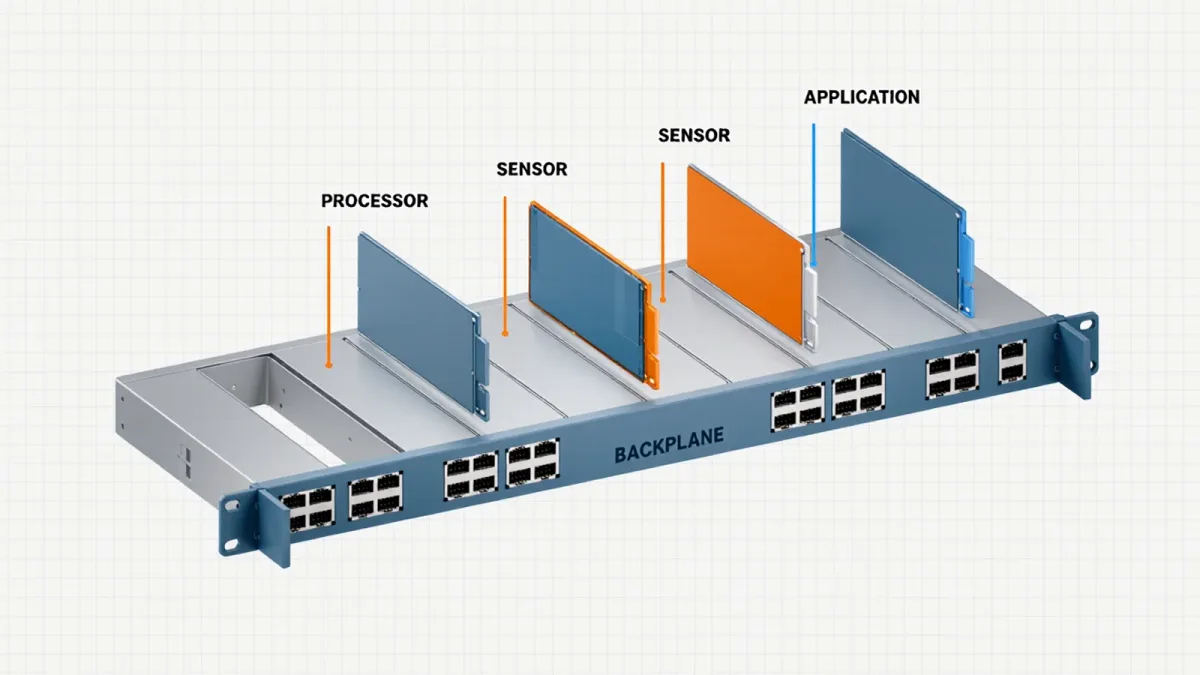
MOSA is not a product but a contracting and design requirement: major systems must separate functions behind published interfaces so components are replaceable, competition survives past initial fielding and technology insertions do not demand bespoke integration each time. In practice that means modular processor cards, standardized backplanes, middleware that hides platform-specific code and data contracts between applications.
The statutory mandate, in effect since 2019 per Department of Defense policy, requires a modular open systems approach in major acquisition programs, with program offices documenting how they meet it and receiving review attention when they do not. The Defense Department's acquisition policy treats MOSA as a default, not an option, for electronics-intensive systems.
The standards zoo, briefly
- Open Mission Systems: the Air Force-origin architecture for airborne mission systems, defining service-based interfaces so mission applications move between platforms.
- HOS/T, or HOST/T: hardware open systems technologies standards for avionics processing, packaging and interconnect, developed with Navy leadership.
- SOSA: the Sensor Open Systems Architecture, aligning sensor vendors on common plug-in card standards.
- FACE: the Future Airborne Capability Environment, a software standard for portable avionics applications.
- VICTORY: the Army's ground-vehicle architecture, the land-side cousin of the same idea.
Why do open architectures speed up upgrades?
Because the integration work is paid once. Under a closed architecture, adding a new radio, sensor or algorithm means negotiating with the incumbent, who owns the interfaces, then re-certifying the whole system. Under a conformant open architecture, the new component meets a published interface, slots into a standard card or service slot, and inherits the existing certification baseline.
The Air Force demonstrated the concept early with Open Mission System experiments in the 2010s, integrating new mission payloads onto legacy bombers and command aircraft in weeks rather than the years closed systems required, per Air Force program reporting. That speed is the entire value proposition: faster fielding of electronic warfare updates, new datalinks and software-defined capabilities on schedules measured in months.
What does MOSA change for industry?
It moves competition from platform monopolies to component markets. Incumbent primes no longer own the sole path into an aircraft's mission computer, and second-tier vendors can sell conformant cards, middleware and applications across programs. Buyers get leverage: the government retains interface rights, technical data and the ability to recompete upgrades.
Contractors adapt in different directions. Prime integrators sell their architecture-management and certification roles; specialists sell components and apps. The winners in an open market are whichever vendors best exploit the standards, which is precisely the behavior MOSA was legislated to encourage.
The certification wrinkle
Openness does not remove airworthiness work. Swapping an avionics module still requires safety review, and programs invest in incremental certification processes so standards-conformant components carry their verification evidence with them. The promise is lower, faster certification, not none.
How is MOSA enforced?
Three ways. Contractually: solicitations require conformant interfaces and deliverable interface control documents. Institutionally: the Department of Defense reviews MOSA implementation during milestone decisions and can flag non-compliant programs. Legislatively: Congress keeps pressure through reporting requirements and oversight hearings when programs propose closed designs.
Programs also lean on consortia that own the standards, where government, primes and vendors jointly publish interface specifications and conformance rules. Membership in those bodies has become a de facto prerequisite for selling into US airborne mission systems, per industry participation rosters.
What are the limits of openness?
Standards lag technology, and a conformant system is only as good as its interface definitions; a poorly specified standard just makes lock-in cheaper. There is also a security dimension: published interfaces demand careful key and software protection so openness does not become an attack surface, which is why the standards include explicit security annexes.
Finally, legacy fleets convert slowly. Retrofitting a 1990s mission system into a conformant architecture costs money that competes with new capability, so most services apply MOSA hardest to new starts and incremental upgrades. The direction of travel, however, is fixed: statutory law requires it, and acquisition policy enforces it.
What does a conformant system look like in the aircraft?
Open the mission equipment bay of a conformant aircraft and the architecture is visible as hardware: standard-format processing cards in a common chassis, a switch fabric moving data between them, and power and thermal interfaces designed to published profiles. Above the hardware sits middleware that decouples applications from the platform, so a targeting app or an electronic warfare technique does not know which processor it runs on.
The software side is organized as services. Sensor tracks, weapon interfaces and communications ride published data contracts, so adding capability means adding a service rather than editing the monolith. Programs describe this as building the aircraft's computing spine once and then upgrading muscles on competition, per program office descriptions.
From lab to flight line
Deployment is where openness earns its keep. When a new datalink or countermeasure qualifies under the standards, fleet integration reduces to installing a card or loading an application and verifying interfaces, with much of the verification evidence inherited from the developer's conformance testing. Units have demonstrated payload and software integrations on legacy platforms in weeks during Open Mission System trials, per Air Force reporting, a cadence closed architectures could not match.
How do coalition operations benefit?
Open standards ease the allied problem that closed architectures never solved. When partner nations build to the same interface specifications, interoperability ceases to be a bespoke gateway project for each exercise or coalition, and third-party vendors across allied industrial bases can supply conformant components into shared fleets.
Standardization also disciplines procurement prices. Because interfaces are public, an allied air force can recompete an upgrade among multiple vendors rather than returning to the original integrator by default. Export control still gates the most sensitive functions, but the interface layer itself was designed to be shared.
What should industry and readers track?
Three indicators show how fast the transition is running. The share of new program solicitations requiring conformance to published standards, the growth of consortium membership rosters among mid-tier vendors, and the cadence of announced rapid capability insertions on conformant platforms. Where those three accelerate, closed architectures are being priced out of the market the statute built for them.
MOSA's critics note that standards can ossify and that conformance paperwork has its own cost, and both objections have merit. But the alternative that MOSA replaced, sole-source interfaces held by an incumbent for the life of a fleet, had a thirty-year track record of slow upgrades and rising prices. The statute chose competition, and the aviation enterprise is being rebuilt around that choice one interface at a time.
Program history supplies the proof cases. Airborne platforms that adopted Open Mission System interfaces mid-life have accepted new payloads, radios and software applications from multiple vendors without returning to the original integrator for each insertion, per Air Force reporting on the trials. Those demonstrations, more than any policy memo, are why the requirement now enjoys bipartisan legislative support and why solicitations cite standards conformance as a matter of routine.