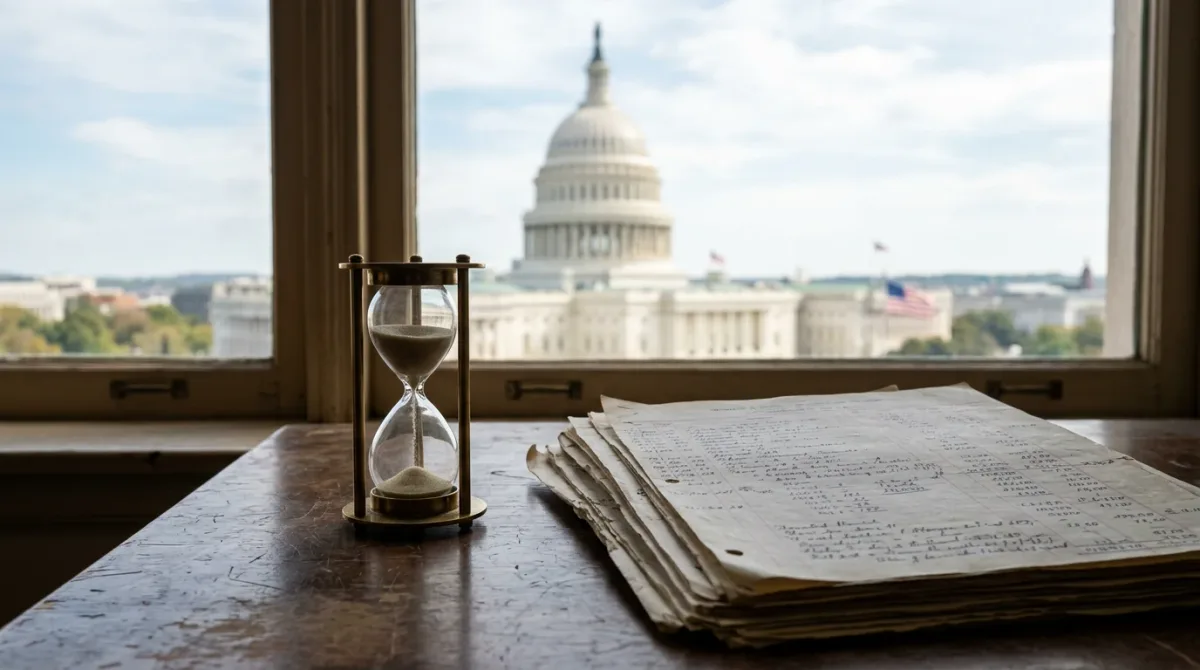
Congress has completed its full annual budget process before the start of a fiscal year only three times in the past 47 years, most recently in fiscal 1997, according to the Government Accountability Office. That track record is why continuing resolutions, or CRs, have become the default mechanism for keeping federal agencies funded when regular appropriations bills stall in the House and Senate.
What Is a Continuing Resolution?
A continuing resolution is a temporary spending law that keeps federal agencies operating when Congress and the president have not enacted final appropriations bills, according to a Government Accountability Office explainer. It typically extends funding at the prior year's levels for a set period, and lawmakers can attach targeted adjustments — known as anomalies — to individual accounts. A full-year CR, GAO notes, functions much like a final appropriations act for the remainder of the fiscal year rather than a short-term patch.
CRs are distinct from the twelve regular appropriations bills that fund specific parts of government, such as defense or labor and health programs. Rather than setting new spending levels agency by agency, a CR generally freezes the status quo while lawmakers keep negotiating. The table below outlines the basic differences GAO draws between the two vehicles.
| Feature | Continuing Resolution | Full-Year Appropriations Act |
|---|---|---|
| Funding levels | Generally prior-year levels, with limited anomalies | New levels set for each account, agency by agency |
| New programs or policy changes | Typically none, absent an anomaly | Can create, expand or end programs |
| Duration | Fiscal 2010-2022 CRs ran 1 to 176 days, per GAO | Covers the full fiscal year once enacted |
| Legal effect | Bridges a funding gap; full-year version can substitute for final bills | Final, account-by-account spending authority |
Why Does Congress Rely on Continuing Resolutions So Often?
Between fiscal 2010 and fiscal 2022, Congress enacted 47 continuing resolutions, ranging from as short as one day to as long as 176 days, according to GAO. The recurring use reflects how rarely the two chambers and the White House agree on all twelve appropriations bills by the Oct. 1 start of the fiscal year.
When neither a CR nor final appropriations are in place, the result is a lapse in funding — a government shutdown. GAO's review identifies shutdowns in fiscal years 2014, 2018 and 2019 as consequences of that gap. Each of those episodes followed the same basic pattern: the twelve annual appropriations bills, or a stopgap covering them, expired without a successor in place, and agencies without other funding authority had to stop non-excepted operations until Congress and the president reached agreement.
What Actually Changes — and What Stays the Same — Under a CR?
A continuing resolution proposal that Senate Appropriations Committee Democrats circulated for fiscal 2026 illustrates how specific those adjustments can get. According to the committee's section-by-section summary of the measure, it would have extended funding through the earlier of Oct. 31, 2025, or enactment of the relevant full-year appropriations act, generally holding most agencies at fiscal 2025 funding levels while excluding emergency relief spending and certain Office of Management and Budget reporting requirements.
Even within that general freeze, the summary describes specific dollar anomalies attached to individual accounts, including:
- $8.2 billion for the WIC nutrition program
- $30 million for U.S. Marshals Service protective security
- $28 million for Supreme Court justice residence protection
- $52 million for judiciary court security
- $186.5 million combined for legislative branch security enhancements
- $491 million restored for the Corporation for Public Broadcasting
The proposal also includes restrictions common to CRs: it would bar new Defense Department production starts and multiyear procurement contracts, and it would prohibit agencies from implementing presidential budget changes that Congress has not separately enacted. The summary further describes a new $20 million appropriation for an Office of Management and Budget inspector general, a permanent extension of enhanced Affordable Care Act tax credits, and extensions of Medicare, Medicaid and Veterans Affairs program authorities through Oct. 31, 2025.
What Happens Inside Agencies While a CR Is in Effect?
GAO reviewed how continuing resolutions affect day-to-day operations at the Departments of Health and Human Services, Agriculture and Education and found consistent strain even short of a shutdown. Staff time goes toward contingency planning for a potential lapse rather than regular program work, and agencies slow or halt hiring, sometimes declining to extend job offers until funding certainty returns. Travel funds can become inaccessible, and grant-making offices face uncertainty about how much money will ultimately be available.
In response, GAO found, agencies have sought funding flexibilities such as multiyear appropriations and have adjusted the language in grant announcements to account for funding uncertainty. The strain GAO documented was not tied to any single CR; it reflects a recurring operational pattern at agencies that regularly work under stopgap funding rather than final, account-specific appropriations.
What's the Legal Framework Behind Funding Gaps?
The rules governing continuing resolutions and funding lapses sit inside a much larger body of federal fiscal law. Principles of Federal Appropriations Law — GAO's multivolume legal treatise known as the Red Book — devotes a dedicated chapter to continuing resolutions as part of a fifteen-chapter framework covering how appropriations may be used by purpose, time and amount, along with the separate Antideficiency Act restrictions that limit agency spending once authority lapses. GAO has been updating the Red Book edition by edition; as of its most recent posted status, the first three chapters had been revised to a fourth edition while the remaining chapters, including the one on continuing resolutions, remained in their third edition pending revision.
That legal architecture is why disputes over continuing resolutions so often end up framed in procedural terms — what an agency may obligate, for how long, and under what account — rather than as a single up-or-down political question. The purpose, time and amount limits GAO catalogs in the Red Book are the same constraints agency lawyers and appropriators cite when a stopgap measure is being drafted or challenged.
For a related politics perspective, read Congress Turns to Stopgap Bills to Avoid Government Shutdowns.
For more context, read How Continuing Resolutions Keep Federal Agencies Funded.
For more context, read authorizations.
For more context, read state.