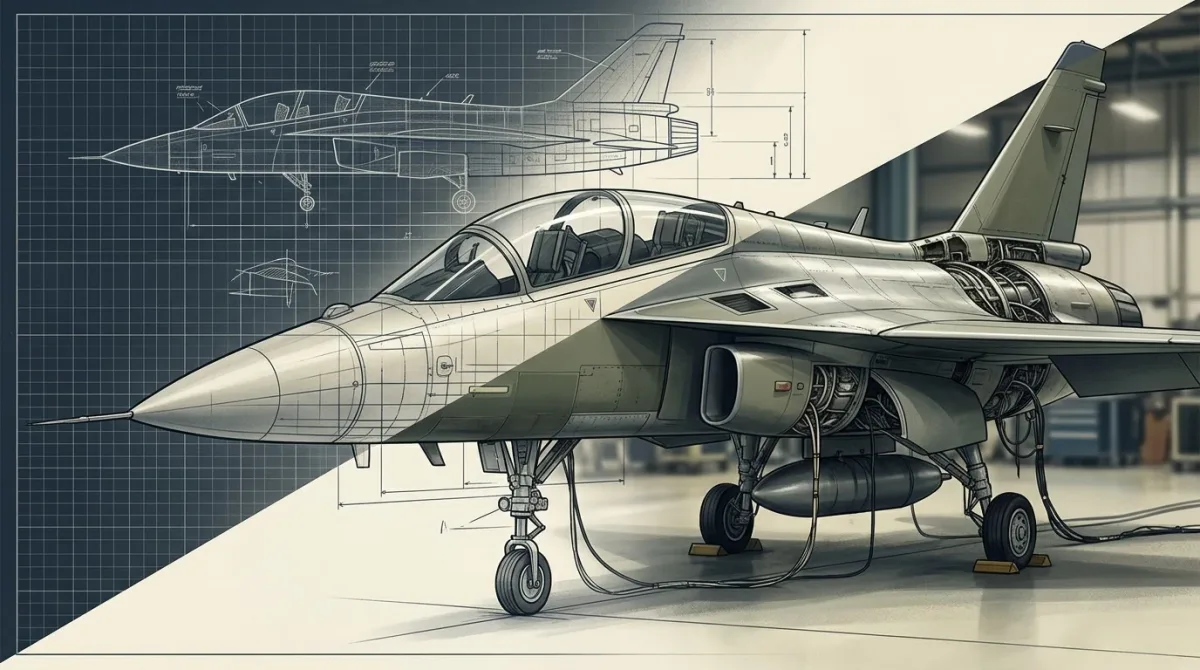
Milestone C — the Pentagon's decision gate between prototype development and production — is the review that authorizes an aircraft program to enter low-rate initial production, per DoD Instruction 5000.85. The Milestone Decision Authority signs off only after testing, a stable design and full funding are confirmed, the same review the Air Force's T-7A Red Hawk trainer passed on April 23, 2026.
What Does a Milestone C Decision Actually Approve?
Milestone C authorizes a program to leave the Engineering and Manufacturing Development phase (EMD, the stage where a design is built and tested but not yet mass-produced) and enter the Production and Deployment phase, where it can begin low-rate initial production (LRIP, a small, capped batch built before full-rate manufacturing) or limited deployment, and award the contracts to do it. That is the framing given by DoDI 5000.85 and by the Defense Acquisition University's Adaptive Acquisition Framework guide, the Pentagon's own training reference for the process.
The instruction lists the entrance criteria a program has to clear before a Milestone Decision Authority (MDA, the official empowered to approve the gate) will sign off:
- Acceptable developmental test and evaluation results, plus any early operational test and evaluation
- Evidence the production design is stable
- Mature software and no significant manufacturing risks
- Demonstrated cybersecurity, interoperability and operational supportability
- Costs within affordability caps, with full funding programmed across the Future Years Defense Program
None of those are formalities in the sense of a rubber stamp. DoDI 5000.85 frames the entrance review as the point where the government stops paying to discover problems in a lab and starts paying to build hardware at scale — which is why a program that has not proven a stable design or full funding does not get to move, regardless of schedule pressure.
Why Does Low-Rate Production Come Before Full-Rate Production?
LRIP exists to cap financial and technical exposure: the Milestone Decision Authority approves a small initial quantity so that manufacturing problems surface on dozens of aircraft, not hundreds, before a full-rate commitment is made. DoDI 5000.85 does not set a standard LRIP quantity; it lets the MDA determine that number for each program individually, earlier in the acquisition timeline.
The T-7A Red Hawk's own Milestone C illustrates the mechanic. The Air Force's Milestone C approval, announced April 23, 2026, cleared an initial LRIP lot of 14 aircraft under a $219 million contract to Boeing Defense, Space & Security covering the jets plus spares, support equipment and training, according to an Air Force release. The full program calls for 351 aircraft and 46 simulators delivered over the following decade to five Air Education and Training Command bases — a production run more than twenty times the size of the first LRIP lot, which is the point of splitting it into a small batch first.
The Air Force also structured the T-7A's path to that first lot as a phased, "active management" arrangement between the service, Air Education and Training Command and Boeing, with the Air Force's own release noting the government sought individual approval for each of the first three LRIP lots rather than committing to the full run at once — an added layer of caution on top of the standard Milestone C review.
How Long Does a Program Typically Take to Reach This Point?
Slower than the original plan, on average: DOD programs now take nearly 12 years from start to initial capability, an increase of about 18 months, according to the Government Accountability Office's June 2025 weapon systems assessment of 30 major acquisition programs. GAO's report found several programs it reviewed reported schedule delays of more than a year, and combined cost estimates across those 30 programs rose $49.3 billion, with the Air Force's Sentinel missile program alone accounting for over $36 billion, or 73 percent, of that growth.
The T-7A's own schedule history tracks that pattern. The table below lines up the trainer's shifting target dates and production numbers against the sourced record.
| Milestone | Date / figure | Source |
|---|---|---|
| Original 2018 program baseline for Initial Operational Capability (IOC) | 2026 | Breaking Defense |
| Spring 2025 budget forecast for IOC | 2028 | Breaking Defense |
| Milestone C decision | April 23, 2026 | Air Force release |
| Current IOC target | 2027 | Air Force release |
| First LRIP lot / contract value | 14 aircraft / $219 million | Air Force release |
That is an IOC date that has moved three times since the 2018 contract award — from 2026 to a 2028 forecast and, per the Air Force's own release, back to 2027 — before the program ever reached its production decision.
What Pushed the T-7A's Milestone C Timeline Back a Year?
Boeing had booked more than $1 billion in losses on the T-7A's fixed-price development contract by early 2025, and the Air Force pushed the Milestone C decision back roughly a year while it reworked the path to production, Breaking Defense reported in January 2025. At the time, Air Force acquisition chief Andrew Hunter said of the 2018 fixed-price contract's structure: "The nature of the contract, it's not a bad contract, but increasingly, over time, as you get further and further from the center point of what the contract was designed to do, the incentives get more and more misaligned."
Rather than proceed to Milestone C on the original schedule, the Air Force added four additional production-representative test aircraft and set aside funds for incentive agreements meant to resolve outstanding issues, including expanding the jet's range, while holding the FY25 budget line at $362 million, per Breaking Defense's reporting. Boeing's interim defense CEO at the time, Steve Parker, described the revised approach as a way "to provide a production-ready configuration to the Air Force prior to low-rate initial production, further reducing any future risk to production" — a company characterization of its own fix, not independent confirmation that the risk was resolved.
That reworked approach is what the Air Force credited when it announced Milestone C fifteen months later. The extra test aircraft and the phased, lot-by-lot LRIP approval structure both trace directly to the problems Hunter and Parker described in January 2025.
Who Signs Off on Milestone C, and What Happens Next?
The Milestone Decision Authority approves the gate, and for the T-7A that authority sits within the Air Force acquisition chain rather than with a single office named in the service's public release. Acting Assistant Secretary of the Air Force for Acquisition, Technology and Logistics William Bailey called the decision "a testament to the dedicated government and industry teams who worked diligently to overcome complex technical hurdles," while Program Executive Officer for Training Rodney Stevens said the approval "signifies our confidence in the aircraft's design and readiness to begin producing this game-changing capability at rate" — a program office's assessment of its own milestone, reported here as a claim rather than an independent finding.
Passing Milestone C does not by itself guarantee the rest of the schedule holds. It authorizes the first LRIP lot and the contracts to build it; the Air Force still has to award, fund and execute two more LRIP lots individually under the active-management structure before any full-rate production decision, with IOC still targeted for 2027, per the Air Force's release. Brig. Gen. Matthew Leard, director of plans, programs, requirements and international affairs at Air Education and Training Command, framed the aircraft's purpose plainly: "The T-7A Red Hawk is the tool we need to train the next generation of combat aviators." Whether the remaining LRIP lots clear on the schedule the Air Force has now set is not yet known.
Frequently Asked Questions
What is the difference between Milestone C and a full-rate production decision?
Milestone C authorizes a program to enter production at a low, capped rate so problems surface on a small batch of aircraft first. A separate, later full-rate production decision is required before a manufacturer can build at the program's full planned quantity, per DoDI 5000.85.
Does an LRIP quantity apply to every acquisition program the same way?
No. DoDI 5000.85 does not set a standard LRIP number; the Milestone Decision Authority sets a preliminary quantity earlier in the program and finalizes it around Milestone C, as the T-7A's 14-aircraft first lot shows.
Who has the authority to approve Milestone C?
The Milestone Decision Authority, a role assigned per program under DoDI 5000.85, approves entry into the Production and Deployment phase after reviewing testing results, design stability, software maturity, manufacturing risk and funding.
Does clearing Milestone C mean a program's schedule problems are over?
Not necessarily. GAO's June 2025 assessment found major defense programs are taking nearly 12 years on average to reach initial capability, and the T-7A itself reached Milestone C about a year later than its Air Force had originally targeted before the decision.
For more coverage, see Btrust to host a ‘Developer Day’ at the Africa Bitcoin Conference 2024.
For more context, read Biden-Harris Administration Announces California’s Launch of First Phase of Federal Home Energy Rebate Programs to Help Lower Families’ Utility Bills.
For more context, read bitcoin.
For more context, read A Spotlight on Bless Web Designs.