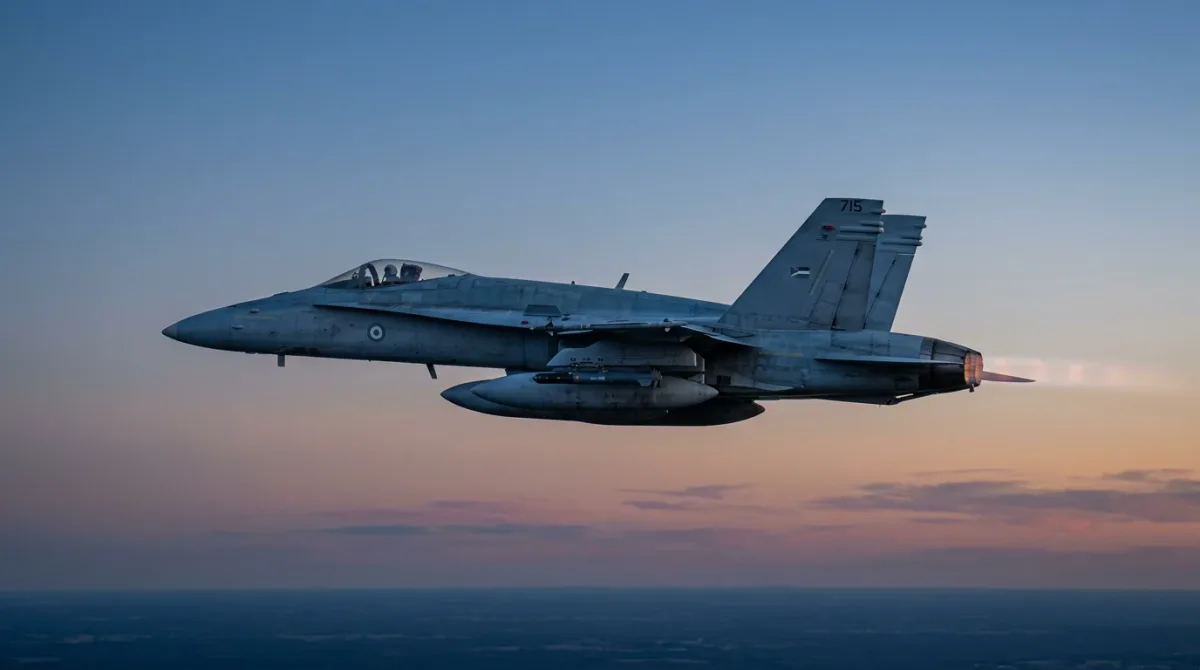
Infrared search and track, or IRST, is a passive sensor that finds and tracks aircraft by their heat signature instead of by bouncing radar energy off them. On U.S. Air Force F-15C Eagles, that sensor is Lockheed Martin's Legion Pod, which the company says entered production after flight tests on the F-15C and F-16 airframes.
What problem is IRST actually solving?
A fighter's radar works by shouting into the sky and listening for an echo, and any receiver tuned to the right frequency can hear that shout from much farther away than the radar itself can hear the echo back. That asymmetry is the whole reason radar-warning receivers exist, and it is also why a jet that wants to find an opponent without being found first has a problem. Lockheed Martin describes Legion Pod as a "multi-function sensor system that supports collaborative targeting operations in radar-denied environments," which is the company's own framing of the same problem: sometimes the smart move is to stop shouting.
IRST answers that problem by using long-wave infrared technology to detect the heat an aircraft cannot help producing — engine exhaust, skin friction at speed, and hot metal around the powerplant — according to Lockheed Martin's product materials for the underlying IRST21 sensor. Because the aircraft carrying the sensor emits nothing, there is no signal for an adversary's warning receiver to catch. That is the whole trade: range and all-weather certainty, traded for silence.
How does the sensor turn a heat blob into a usable track?
IRST21 is Lockheed Martin's "next generation" of a sensor lineage the company says has logged more than 300,000 flight hours on F-14 Tomcats and international F-15 fleets — a manufacturer-claimed figure with no independent tally published. The pod version built around it, marketed as Legion Pod, houses the IRST21 sensor and an onboard processor inside a 16-inch-diameter body that Lockheed Martin says is "a fully integrated, self-contained sensor system designed to support multiple platforms" without touching the host aircraft's flight software.
The processor's job is to turn a faint thermal contrast against the sky into a stable track: filtering out background clutter, correlating detections across successive scans, and outputting an angular position — bearing and elevation — toward the target. A single IRST looking at a target head-on can tell a pilot exactly where to look; what it cannot do alone is tell the pilot how far away the target is, because a single passive sensor has no round-trip echo to time. Publicly available sources do not establish a specific detection-range figure for Legion Pod or IRST21; Lockheed Martin's own materials describe only that the system provides "weapon-quality accuracy," a claim the manufacturer makes about its own product and that no independent test result available to the public confirms or denies.
How does a heat signature become a missile shot?
The published record of actual U.S. Air Force test shots lays out the engagement chain in order, drawn from an Air Combat Command release and a subsequent squadron announcement:
- Passive detection. The IRST sensor picks up a target's thermal signature and begins building a track without radiating anything itself.
- Ranging. Because one IRST alone cannot range a target by timing an echo, range has to come from elsewhere — triangulation between two datalinked pods, or a fix from the aircraft's own radar used briefly or not at all.
- Cueing the weapon. The resulting track — now carrying both angle and range — is handed to the missile's guidance system as a targeting solution.
- Shot. The pilot fires.
That sequence was demonstrated twice on the record. On July 8, 2020, an F-15C Eagle from the 85th Test and Evaluation Squadron fired an AIM-9X Sidewinder using Legion Pod targeting data at Eglin Air Force Base, Florida — Air Combat Command's own release states the sensor lets pilots "identify, track and shoot enemy aircraft in a RADAR jamming environment to include stealth aircraft that a traditional radar may not see." Five days later an F-16DM flew the pod's first operational sortie. Then, on August 5, 2021, the same squadron went further: an F-15C fired an AIM-120 AMRAAM cued by an IRST track and struck a QF-16 target drone, according to an Air Force release distributed through the Defense Department's official visual-information service. That shot combined the pod's passive infrared track with a brief assist from the jet's APG-63v3 radar to build the missile's targeting solution, and Maj. Brian Davis, quoted in the release, called it significant because it let the squadron "achieve detection, tracking, targeting, weapons employment, and verification of an intercept without being dependent upon RADAR energy."
Neither shot was against a real adversary aircraft, and neither release discloses the missile's lock-on range or the target's radar cross-section — those remain unconfirmed for the public.
Where has the Air Force actually put this hardware?
Legion Pod's path from prototype to operational squadron has been documented in stages across manufacturer, Air Force, and independent reporting.
| Platform | Status as publicly reported | Sensor / variant |
|---|---|---|
| F-15C Eagle | Operational; photographed on Kadena Air Base jets in December 2021 | Legion Pod carrying IRST21, internally designated AN/ASG-34 |
| F-16 Fighting Falcon | Flight-tested; first operational sortie July 13, 2020 | Legion Pod (podded IRST21) |
| F/A-18E/F Super Hornet | Fielding underway, separate from the podded design | IRST21 mounted in the nose of the centerline fuel tank |
| Navy Block II | In development | IRST21 Block II |
The Kadena deployment carries its own logic: a report on the 67th Fighter Squadron's pods notes the base's proximity to China, North Korea, and Russia made it "likely to be among the first in line to get the Legion Pod," since Pacific Air Forces jets are the ones most likely to face stealth aircraft such as China's J-20. On the acquisition side, the trade outlet Breaking Defense reported 38 low-rate initial production Legion Pod systems under contract as of the program's mid-stage milestones, and a separate roughly $485 million Navy indefinite-delivery contract for IRST21-family hardware signed in May 2024, citing Air Combat Command and program officials. Lockheed Martin's own materials say it planned to supply 170 IRST21 systems to the Navy — a manufacturer commitment, not an independently confirmed delivery count.
What can't the public record confirm?
Every specific performance number in this article traces to either a manufacturer datasheet claim or an official test announcement, and neither source is a substitute for the other. Lockheed Martin is the attributed source of its own figures — "weapon-quality accuracy," the 300,000-hour heritage tally, the 170-unit Navy commitment — and none of those numbers has been independently tested or verified by a third party in anything publicly available. The Air Force releases, in turn, confirm that specific shots happened on specific dates using specific squadrons, but they do not publish detection ranges, lock-on distances, or a technical description of exactly how the datalink-based triangulation resolves range between two pods. The War Zone separately reported on that datalink work, built around a test during the Northern Edge exercise in Alaska in May 2021, quoting Lockheed Martin's Jim Ni and Kenen Nelson describing how a Tactical Targeting Network Technology link lets two Legion Pods produce a full three-dimensional track — but that description, too, comes from the manufacturer characterizing its own system, not an outside evaluation.
None of this is classified, and none of it should be read as more precise than it is. The honest summary is that the mechanism — passive detection, cross-cueing for range, handoff to a weapon — is confirmed in sequence by official test announcements, while the specific numbers that would let anyone calculate an engagement envelope remain either manufacturer claims or simply undisclosed.
Frequently asked questions
- Is IRST meant to replace a fighter's radar? No. Official Air Force materials describe Legion Pod as a complementary sensor for radar-denied moments, and the August 2021 AIM-120 shot still used a brief assist from the F-15C's APG-63v3 radar rather than IRST alone.
- Which jets carry it today? Lockheed Martin lists flight tests on the F-15C and F-16; Air Force releases and photography place operational pods on Kadena-based F-15Cs, while IRST21 is separately fielding on the Navy's F/A-18E/F in a nose-mounted, non-podded form.
- How far can it detect a stealth aircraft? Publicly available sources do not establish a range figure. Lockheed Martin's public materials use only qualitative language, and no independent test result is publicly available to confirm or contradict it — this remains unconfirmed.
- Does a passive shot mean the target never knows it's being engaged? Passive tracking avoids the radar-warning cues many aircraft rely on, per Air Combat Command's own framing of the capability, though official statements describe IRST as working alongside radar rather than eliminating the need for it entirely.
For a related aviation perspective, read Here is how infrared search and track lets fighters find stealth jets with the radar off.
For more context, read What the FAA requires before a drone can spray your fields.